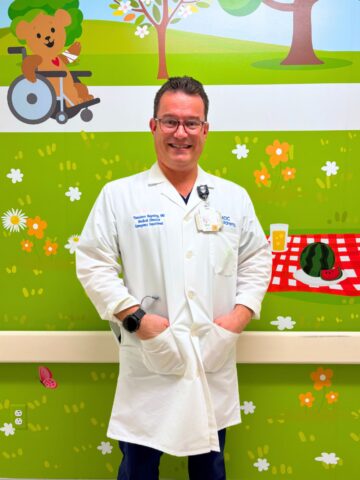
Pediatric neurologist and epilepsy specialist Dr. Daniel Shrey is the latest clinician scientist at CHOC, part of Rady Children’s Health, to earn a master of science in biomedical and translational Science (MS-BATS) from UC Irvine.
The program is designed to give researchers and clinicians the knowledge and tools needed to translate laboratory studies into medical breakthroughs. CHOC pediatric general and thoracic surgeon Dr. Yigit Guner also is a graduate of the MS-BATS program.
“The MS-BATS program profoundly enhanced my understanding of research design, biostatistics, and data interpretation, and it significantly sharpened my grant writing skills,” said Dr. Shrey, who graduated from the one-year program in spring 2025.
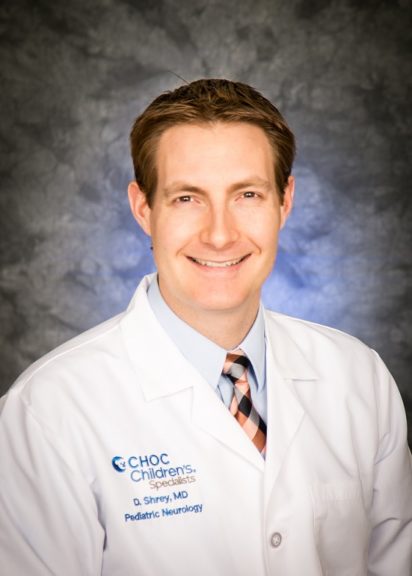
He said the mentorship and training he received has been instrumental in his growth as an independent investigator, culminating in the submission of his first National Institutes of Health R01 grant in 2025.
That grant, submitted in collaboration with Dr. Shrey’s wife, UC Irvine Biomedical Engineering Professor Beth Lopour, will fund a study that will address a critical need in the treatment of infants with Infantile Epileptic Spasms Syndrome (IESS) – a severe epilepsy affecting young children that imparts high rates of lifelong disability.
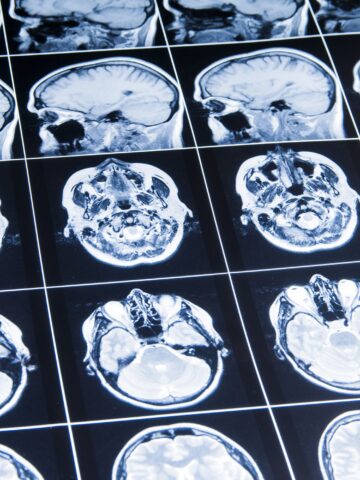
The research project will leverage the National Investigation of Multimodal Biomarkers for Infantile Spasms (NIMBIS) database of 560 children with newly diagnosed IESS to study candidate characteristics of IESS that may help to predict treatment failure, such as clinical, demographic, brain imaging, genetic, and electrical brain signal data.
Dr. Shrey is the lead principal investigator for the national, 20-site NIMBIS project. He and Professor Lopour received a previous NIH R01 grant to research a new way to control pediatric seizures using densely spaced electrodes to map high-frequency oscillations.
A stronger foundation
Dr. Guner completed the program as an assistant professor at UC Irvine, and the experience helped him build significant momentum in his research productivity.
“The training strengthened my foundation in study design, biostatistics, and grant development, and provided a structured environment to refine research questions and build multidisciplinary collaborations,” Dr. Guner said.
Since completing the program, Dr. Guner has expanded his clinical and translational research portfolio, leading and participating in projects across Rady Children’s Health Orange County, formerly called CHOC; UC Irvine; and multiple partner institutions, with a particular focus on neonatal and pediatric surgical outcomes, ECMO, and congenital diaphragmatic hernia.
Strategy alignment
Neurologist and research scientist Dr. Terence Sanger, vice president for research and chief scientific officer at CHOC, said programs like MS-BATS are invaluable for clinicians who want to improve their skills as researchers.
“Enriching the ability of our physician scientists to initiate and undertake leading-edge research is critical to our Research Institute’s long-term strategy,” Dr. Sanger said. “We owe it to our children to not just care for them but to discover for them, and programs like MS-BATS strengthen our mission to keep pushing forward with research to imagine and achieve better outcomes.”
Dr. Shrey said the MS-BATS program’s emphasis on translational science and multidisciplinary collaboration has directly supported his work in developing computational biomarkers for children with severe epilepsy.
“The skills and perspectives I gained through MS-BATS continue to shape my research approach and have had a lasting impact on my career development as a physician-scientist dedicated to improving outcomes for children with epilepsy,” he said.
“I’ve spent the last decade developing myself as both a clinician and a scientist,” Dr. Shrey added. “As my clinical research efforts expanded and my studies became more complex, it became clear that the research training I received during medical school was no longer sufficient for the level of rigor and sophistication I wanted to achieve as a physician-scientist.
“This realization motivated me to apply to the MS-BATS program so that I could strengthen my foundation in clinical and translational research.”
Bench-to-bedside training
Dr. Gerard Slobogean, who recently took over as program director of MS-BATS, said: “MS-BATS is unique in that the curriculum can be personalized to meet each enrollee’s research goals. Whether you’re a medical student, clinician or full-time researcher, we want you to tailor the program to meet your needs.”
Since 2012, MS-BATS has supported translational research. After a decade of success, the program revamped its curriculum in 2023 to remain on the forefront of training investigators to turn biomedical discoveries into clinical practice.
Under Dr. Slobogean’s leadership, MS-BATS is poised for continued growth and expanded impact, which is as critical as ever given the severe workforce shortage of clinical and translational researchers.
“The process of moving from ‘bench to bedside’ is a distinct science, which is why we need MS-BATS,” said Slobogean, who joined UC Irvine in September 2025 as a professor and research director of clinical trials for the Department of Orthopaedic Surgery. “The fundamental problem is the declining pipeline of well-trained investigators capable of conducting high-quality studies along the entire continuum of discovery.”
Throughout the entire translational process, from exploring innovative ideas to conducting clinical trials, the MS-BATS program enhances scientific rigor.
“The program provides the tools needed to successfully move from petri dish to patient care,” says Slobogean, “regardless of where you land on that pathway.”
Learn more about the MS-BATS program and how to apply.