The 4-year-old was lying on his back, a toy monster truck on his tummy.
“Take a deep breath through your nose,” the physical therapist told him. “Keep your mouth closed. Then breath in and fill your belly with air then breath out of your nose.”
The toy truck rose and dropped as Bry Gonzales perfectly executed the breathing exercise.
“That was a good one!” Fabiola Leyva, PT, MPT, said while Bry’s parents, Char and Edgar, cheered him on.
The breathing session took place in a room at the Center for Children’s Health, located on the second floor of the recently opened Joe C. Wen & Family Center for Advanced Care (CAC) near the UC Irvine campus.
Rady Children’s Health Orange County, formerly called CHOC, occupies the entire second floor of the CAC, providing primary and specialty care as well as PT, occupational therapy, and speech language therapy for a variety of patients.
Pelvic floor PT has its own dedicated room.
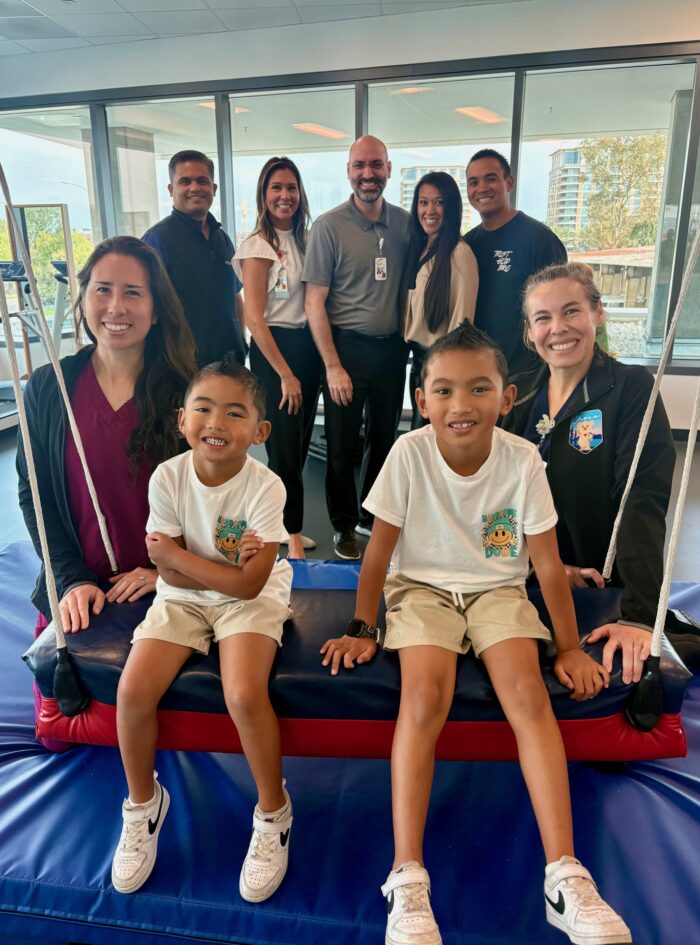
Meet Bry, the first patient
In late October 2025, Bry, who was born with Hirschsprung’s disease, became the first patient at the Center for Comprehensive Pediatric Pelvic Rehabilitation at Rady Children’s, the only pediatric pelvic floor rehabilitation center of its kind in Southern California.
Bry’s condition, in which missing nerve cells in the large intestine cause problems with passing stool, required surgery when he was 4 months old to correct bowel blockage. Prior to that, he underwent a home regimen of rectal irrigations three to four times a day and medication management.
After surgery, Bry was hospitalized on and off for enterocolitis (gut infections), where he needed IV antibiotics and increased rectal irrigations.
At 2 years old, he received his first dose of rectal Botox to promote relaxation of the rectal muscles and reduce constipation, obstruction, and enterocolitis.
When Bry was 4, the colorectal team met with Char and Edgar to discuss the possibility of an additional Botox injection due to recurring symptoms, including constipation, stool leakage, and the need for rectal irrigations.
As Bry grew older, the irrigations became increasingly challenging to manage at home, and his parents expressed concern about potential trauma.
As a result, the team explored alternative management strategies, including adjustments to his bowel regimen with medication management, intensive bowel training, and dietary modifications. Among these changes, the colorectal team recommended a new approach through their new pelvic floor therapy program.
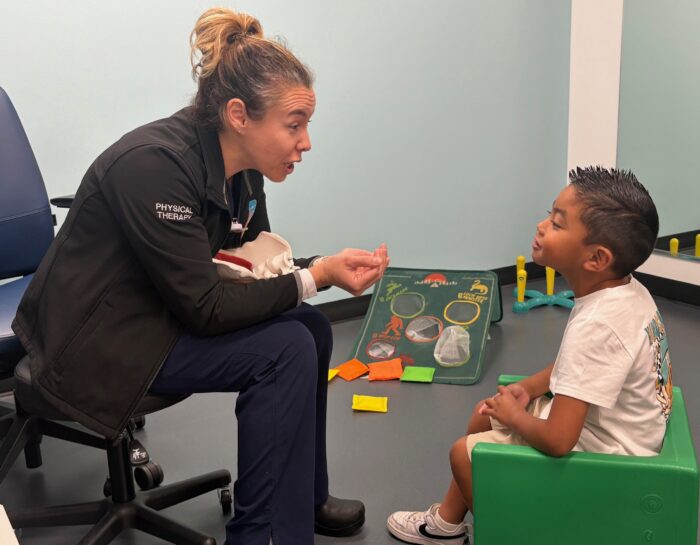
Bry began pelvic floor therapy shortly before he turned 5, working with Fabiola, who has advanced training in both pediatric care and pelvic floor rehabilitation.
Bry undergoes PT with Fabiola an hour a week to learn how to better feel and respond to when he has to go to the bathroom. The program is designed to last three to four months.
In the first few sessions with Fabi, Bry and his parents learned many new techniques that gave him more control of his bowels, becoming more confident and independent in his daily routine.
Unique program
In addition to breathing exercises and other PT, Bry undergoes pelvic floor biofeedback and interoception training – a three-pronged care plan that makes the pelvic floor rehab program unique.
Interoception is the ability to perceive internal body signals, such as knowing when you have to go to the bathroom, sleep, and eat.
The biofeedback element of Bry’s therapy involves state-of-the-art technology that allows him to see how his pelvic muscles work in real time – for example, an animated butterfly on a video screen flies lower when he relaxes his muscles and flies higher when he contracts them — turning pelvic floor rehabilitation into an interactive game.
When Bry started pelvic floor PT in late October, playing games such as beanbag toss with his brother, Dax, 7, between exercises, he still was struggling a bit with toileting.
By mid-January this year, Bry was seeing Fabiola once a month and no longer had to wear pull-up diapers.
“He has been thriving with the pelvic floor therapy,” Char says. “He has the occasional accidents that are more uncontrollable when he gets sick. But that is to be expected. Otherwise, I see such huge progress with his pelvic and core control.
“The most exciting part is seeing the excitement Bry has because he gets to wear his big boy underwear, just like his brother!”
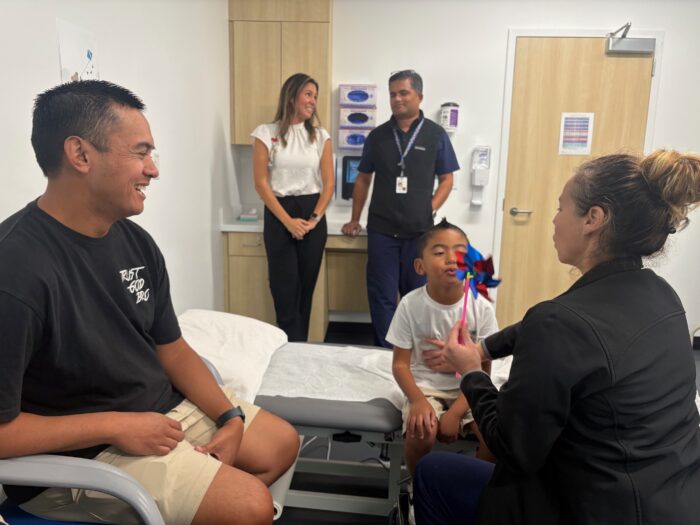
Multidisciplinary team
Getting kids like Bry to achieve toileting independence is the goal of the Center for Comprehensive Pediatric Pelvic Rehabilitation at Rady Children’s, which involves a team of specialists in the integrative health program, colorectal program, and rehabilitation department.
Pelvic floor rehabilitation will serve patients from specialties such as gastrointestinal motility, functional abdominal pain, colorectal surgery, spina bifida, spinal cord injury treatment, orthopedics, general surgery, and urology.
Together, the pelvic floor PT team is filling a big gap in care for children with chronic bowel problems, which includes kids with autism and other neurodevelopmental differences who frequently experience constipation due to sensory sensitivities, restrictive eating habits, reduced physical activity, and differences in interoceptive awareness.
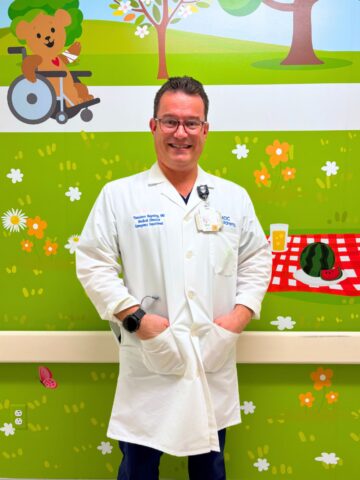
“We focus on the whole child. That means we look at sensory processing, emotions, and developmental readiness – not just bowel function,” says Dr. Ashish Chogle, division chief of pediatric gastroenterology, hepatology and nutrition at Rady Children’s and director of the Integrative Health Culinary Medicine Program.
Planned program expansion
The Center for Comprehensive Pediatric Pelvic Rehabilitation at Rady Children’s was made possible by the GI Integrative Health and Culinary Medicine Program through a generous donation from Sherry and John Phelan.
Project Manager Nicole Trisler, R.N., says the pelvic floor PT program currently only has slots for five patients, with a current wait list of 25 or so patients, but the goal is to accommodate as many as possible moving forward.
“This program reflects our belief that children heal best when we treat the whole child and work together as one team. By integrating pelvic floor rehabilitation into Rady Children’s’ model of care, we’re defending childhood, restoring quality of life, and bringing real hope to families,” Nicole says.
A game changer
Until he underwent pelvic floor rehab, Bry, starting at age 2, had to receive rectal Botox injections, a temporary fix, to relax his rectum. So, achieving complete independence in toileting will be a game changer for him and his family.
“I definitely know he’s mentally there to understand the exercises,” says Char, a nurse at Rady Children’s who works as a Clinical Education Onboarding and Competency Management Specialist. “It’s just a matter of him understanding and learning how to better control his body, and my husband and I have seen so much improvement in his overall bowel regimen.”

Learn more the CHOC Colorectal and Urogenital Center
The CHOC Colorectal and Urogenital Center specializes in providing expert diagnosis and second opinions for colorectal disorders, as well as developing personalized treatment plans using advanced diagnostics and the latest research-based treatment options