Now that artificial intelligence (AI) is everywhere, how does a pediatric healthcare system responsibly use the rapidly evolving technology for good?
Rady Children’s Hospital Orange County has adopted a multi-layered approach involving leading-edge clinical, operational, and research-focused applications, with education and robust governance at the core to ensure that AI is incorporated into the hospital environment thoughtfully, safely, and ethically.
“Our AI education is based on the unwavering belief that humans must be at the core of AI,” says chief of medical intelligence and innovation Dr. Anthony Chang, a pediatric cardiologist. “AI will neverreplace humans, but it will provide support to help us function at our highest level.”
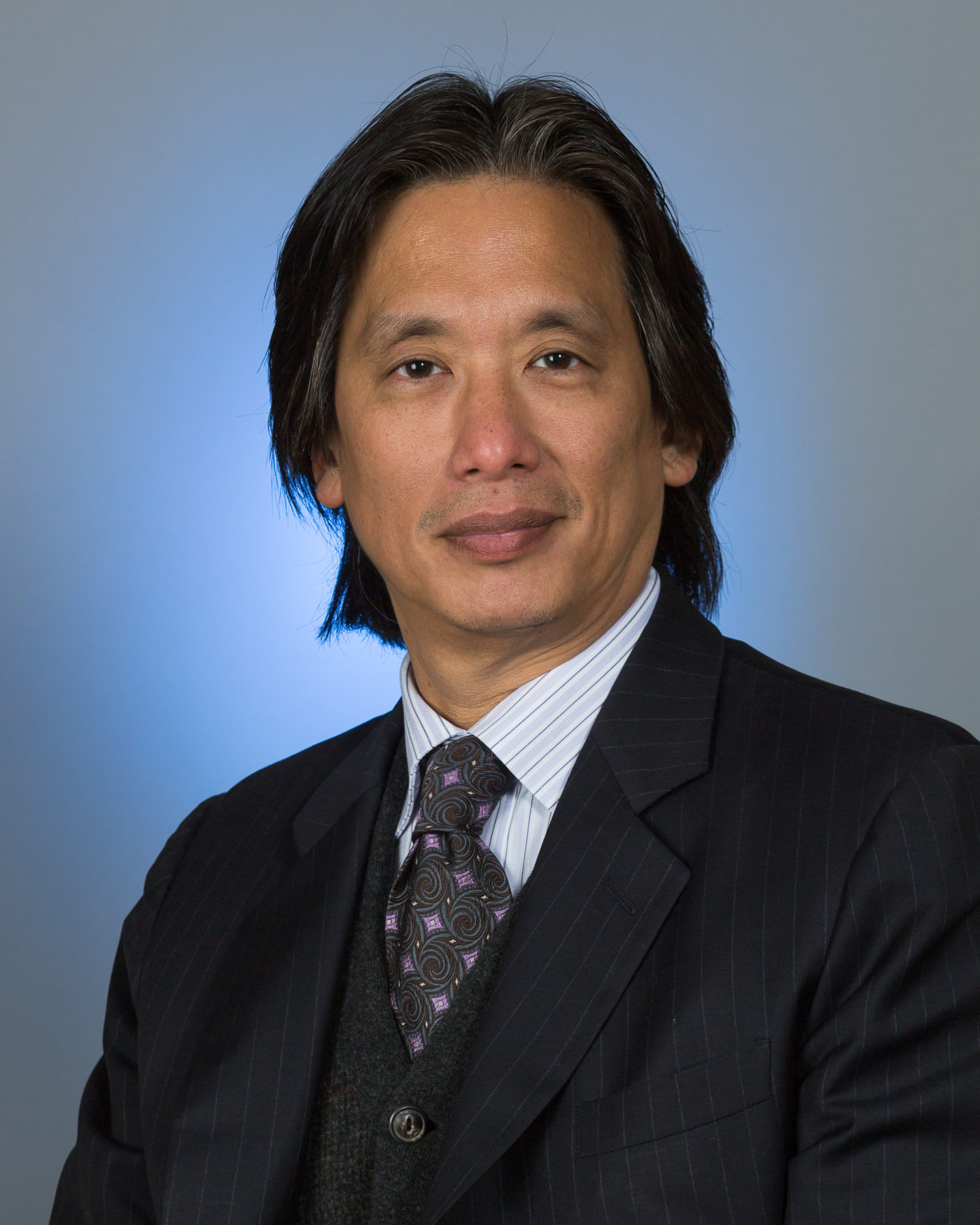
The late Dr. Nick Anas, senior vice president and physician-in-chief and one of the original supporters of AI here, helped lead the recruitment of Dr. Chang. Dr. Anas’ famous phrase regarding pediatric healthcare in general was: “We can’t just be good at this. We have to be great.”
It’s a philosophy being carried out by Dr. Chang, a leading proponent of AI education in healthcare both nationally and internationally, as well as by other RCH leaders.
“One of the great things about Rady Children’s is we tend to be curious and innovative people, and we like to try new things, but we’re not afraid to fail,” says neonatal hospitalist Dr. Steve Martel, chief health information officer.
“That’s really an important part of the AI story: that people understand that not everything’s going to work, but you have to make space for trying and recognizing that the value of AI is there,” adds Dr. Martel. “You just need to find the right opportunities for it. We know that without trying, we won’t have the opportunity to succeed.”
Thoughts from RCH leaders
The successful implementation and adoption of large language models (LLMs) can harness the power of AI to improve healthcare outcomes, according to a recent RCH study.
But the success of the endeavor will require digital readiness, modern infrastructure, a trained workforce, privacy, and an ethical regulatory landscape, according to the report.
RCH authors Dr. Radha Nagarajan, Dr. Sandip Godambe, Dr. Alfonso Limon, Dr. Louis Ehwerhemuepha, Dr. Michael Weiss, Dr. Charles Golden, Adam Gold, John Henderson, Dr. Terence Sanger, and Dr. Martel recently laid out their thoughts on the best way for health care settings to incorporate LLMs effectively in the Journal of Medical Internet Research.
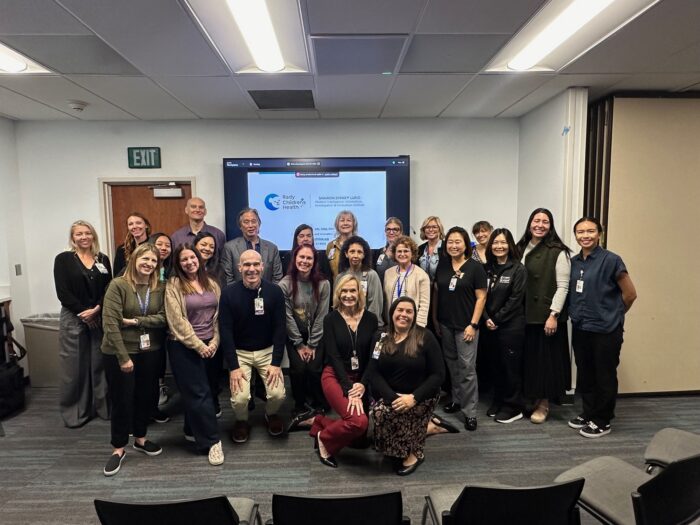
Advanced machine learning techniques, such as deep learning and LLMs, are used to decipher patterns in healthcare data. Healthcare data can be “structured” (around 20%) or “unstructured” (80%).
Structured data includes things like diagnosis codes, while unstructured data includes things like the text in clinical notes. Patterns deciphered by LLMs can help clinicians with decision-making, with subsequent effects on outcomes and key performance indicators (e.g., average length of stay, readmission rates, patient satisfaction scores), the report explained.
The synergy between humans and AI is bidirectional: human intelligence is enhanced through use of AI systems, and AI system accuracy is enhanced by the input of domain experts, the authors wrote.
Additional highlights of the study include:
- Reinforcement learning with human feedback results in an LLM with reduced tendencies toward bias, toxicity, and hallucinations. Training and support must be provided for healthcare professionals, as active clinician engagement will be critical for successful deployment and long-term adoption of LLMs.
- Excitement over the transformative potential of LLMs in healthcare must be accompanied by attention to the corresponding challenges. One major challenge will be ensuring that the benefits of AI systems are equitably distributed among healthcare organizations, especially those that serve poor communities.
- Challenges related to privacy and security will arise when LLMs are trained with sensitive healthcare data, demanding a robust data management strategy. Data de-identification (removal of identifiers such as names and addresses) will be necessary to reduce patient risk.

Education and AI
Rady Children’s Hospital Orange County is ensuring that its care teams and associates are learning about AI readiness.
This August, a half-day physician AI primer for Pediatric Subspecialty Faculty/Children’s Specialists will be held offering CMEs, following on the heals on a successful AI primer for the gastroenterology department and a session for nurses providing CEU credits. MI4 (our medical intelligence, information, investigation, and innovation institute) in partnership with IT continues to offer AI education across the health system.
RCH also has a portal for providers and associates to submit their requests and ideas for AI solutions.
RCH also is committed to educating the next generation of healthcare providers about AI. The CHOC-UCI Resident Rotation, led by Dr. Chang and MI4, in Artificial Intelligence is a groundbreaking, first-of-its-kind pediatric program that offers residents direct clinical exposure to AI in medicine.
Dr. Albert Kim, a third-year resident, completed the rotation this July. He is the first to go through the AI program at RCH. He plans to practice general outpatient pediatrics.
For his AI rotation, Dr. Kim took two, two-week blocks, one in his second year and again in his third. Among his mentors were Dr. Chang and pediatric neurologist Dr. Sharief Taraman.
“It’s a really good and robust training program,” Dr. Kim says of his residency in general. “I feel prepared to be an attending next year and I’ve seen a lot of complex and rare conditions as well.”
As for his AI rotation, Dr. Kim says: “We’re lucky to have Dr. Chang, who is really a champion in AI and a forerunner in pediatric hospitals adopting AI. I worked a lot with him to see how he uses AI and how it’s changing medicine.”
MI4 currently has its third resident in the AI rotation and is looking forward to hosting additional residents like Dr. Kim.
Learning from others
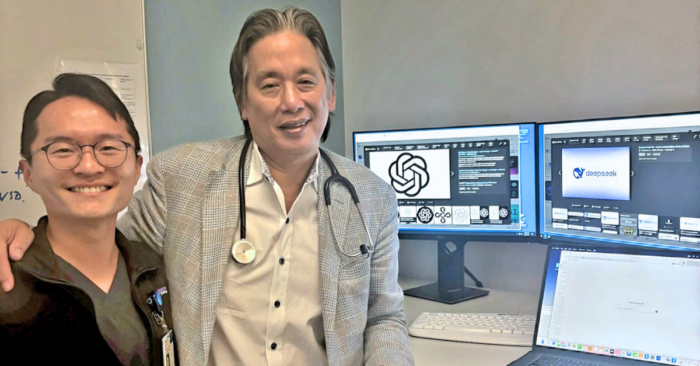
Several RCH clinicians along with AI leaders from around the country volunteer to provide mentor sessions as part of our AI rotation, having met with Dr. Kim to share their expertise, wisdom, and perspectives in AI.
“It was great to hear from all of them and learn about the different ways they participate in this revolution of AI and medicine,” Dr. Kim says.
AI, he adds, has “completely changed the residents’” experience by providing quick and accurate AI tools that assimilate accurate medical information in record time.
“This means we no longer miss any learning opportunities,” says Dr. Kim. “We’re able to harvest every single learning opportunity in real time.”
He cited AI tools such as ChatGPT and OpenEvidence as allowing him to learn concepts at a very rapid and effective pace.
“Without AI, I’d have to do a lot of research, but oftentimes I don’t have time that this would require for every patient case,” Dr. Kim says. “AI allows me to search a concept and helps me learn effectively on a personalized level and also give me citations so I can conduct further research.”
Also useful, Dr. Kim says, is Abridge, an ambient listening technology that uses AI-powered microphones to passively record patient-clinician conversations, automatically generating structured clinical notes and documentation in real-time.
“This allows us to be more personal with our patients and interact with them more,” he says.
Late last year, Dr. Kim led a trainee networking session at an AI conference in San Diego.
“I met a dozen other residents and fellows from around the country and we discussed the tools we use,” he says. “Rady Children’s Health definitely is at the forefront of AI education compared to other pediatric hospitals.”
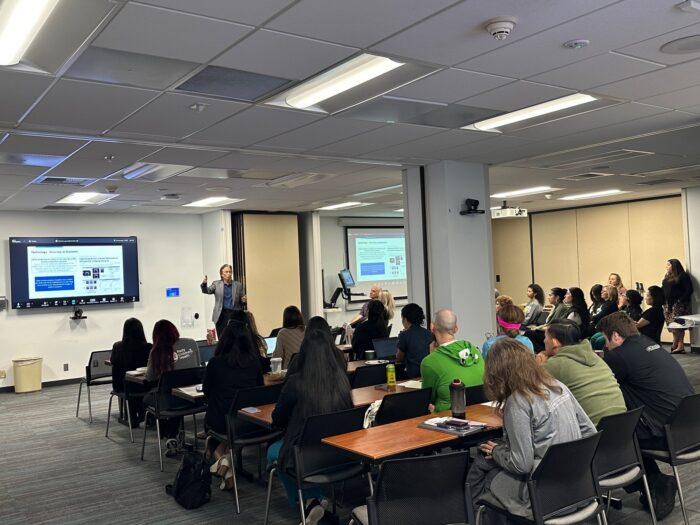
Making AI clinically meaningful
Dr. Sean Dornbush, a pediatric hospital medicine fellow, also participated in the CHOC-UCI AI rotation.
“It was one of the most unexpectedly impactful parts of my training,” he says. “Before the rotation, AI felt abstract. Afterward, it felt tangible and clinically meaningful.”
During the rotation, Dr. Dornbush saw AI used in practical clinical contexts, including AI-assisted documentation and case-based query tools. The experience helped him think more clearly about where AI can reduce friction in clinical work, where it can support learning, and where clinicians still need to verify outputs and rely on clinical judgment.
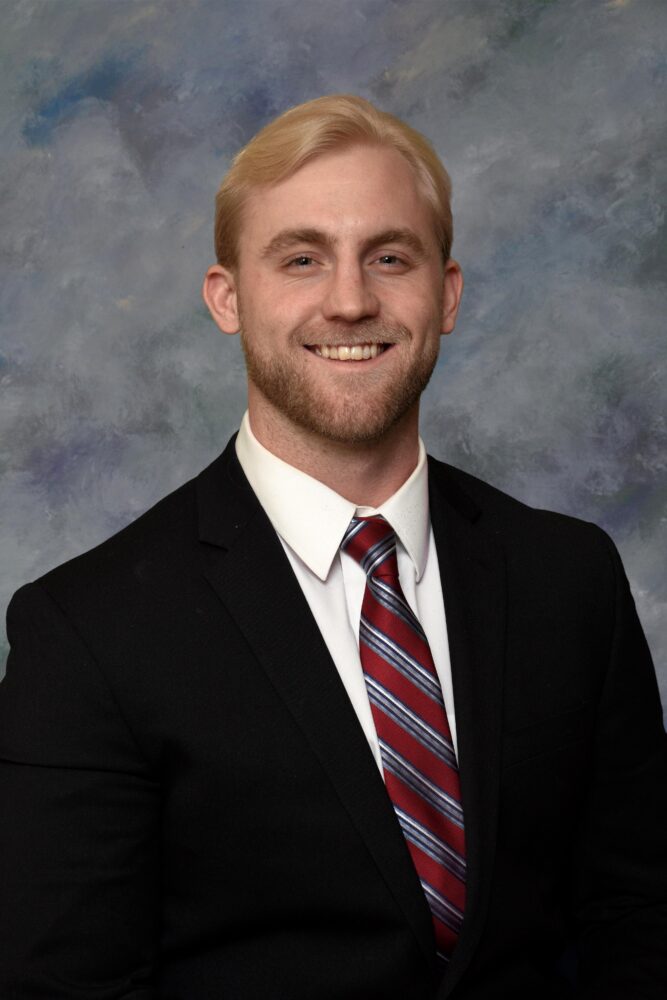
For Dr. Dornbush, one of the most useful parts of the rotation was learning not only what AI can do, but when it should and should not be used. He especially valued practicing human-in-the-loop decision-making.
“It changed how I think about efficiency, communication, and research,” he says. “The mentorship helped make the technology feel practical rather than theoretical.”
Dr. Dornbush’s pediatric hospital medicine fellowship at CHOC began in July 2024 and will be completed in July 2026. He finished his residency training in med-peds and while he is specializing as a pediatric hospitalist through the fellowship, he also continues to practice clinically as an internal medicine hospitalist at UCI.
“I chose Rady Children’s Hospital Orange County because of the collaborative environment, the strong mentorship that supports both clinical growth and innovation, and what is a high-empowering fellowship,” Dr. Dornbush says. “This is a place that invests in its learners. I have always felt very supported as a trainee where my learning is consistently prioritized.”
Highlights for Dr. Dornbush’s AI rotation for residents/fellows in pediatrics include:
- Shadowing clinicians at Rady Children’s Hospital Orange County as they implemented AI into clinical workflows, including the use of AI scribes and AI models to support case-based queries. The experience highlighted practical tools that improve efficiency, reduce administrative burden, and enhance clinical impact.
- The opportunity to assist with projects at Rady Children’s Hospital Orange County and/or develop his own research on AI in pediatric healthcare.
- Weekly meetings with medical intelligence leaders from around the world who are actively leading AI efforts at their respective institutions.
Clinical and operational uses
Dr. Martel explains that from aclinical and operational perspective, AI mostly falls under three areas at RCH:
Information Technology
RCH has instituted several AI tools under the leadership of John Henderson, a seasoned IT leader who is vice president and chief information and digital officer.
RCHChat, a ChatGPT-like tool contained in RCH’s own secure environment so information will not leave the hospital environment, is designed so associates and clinicians can ask questions about RCH data.
For example, a query might be about a marketing campaign launched for a certain topic, or how many e-bike injuries have been treated in the Emergency Department.
“This has the opportunity to revolutionize how we as an organization can access our data and also how we can make it easier to be curious and ask questions,” Dr. Martel says. “This is the most prominent example of what John and his team members are doing from an enterprise-wide perspective.”
RCHChat has been live for about 10 months and isn’t broadly distributed yet. Designers are still working with key clinical and operational partners to further develop user case scenarios. A full rollout is expected in the coming fiscal year.
“We are definitely ahead of the curve on this compared to other pediatric healthcare systems,” Dr. Martel says of RCHChat.
Healthcare Informatics
Dr. Martel’s team has developed three LLM tools: one for nursing policies, one for HIM (health information management) policies, and one for language translation.
Today, when people need to get information on an RCH nursing policy, they conduct a keyword search on a policy manager platform. The problem is, that platform doesn’t understand context, so it pretty much returns hundreds of policies that have a desired keywork. Then the user has to sift through dozens of documents to find the policy he or she is looking for.
“It’s very inefficient,” Dr. Martel notes. “What we’ve done is take all the nursing policies and put them into a SharePoint file and pointed an LLM at that and now, within the Microsoft Teams studio, nurses can query policies not using keywords but by asking the actual question they want answered.”
For example: How frequently should I change a dressing on a central line? (The answer is within 24 hours).
The tool, called Nu Assist, allows nurses to ask a question voice to text. An LLM returns the exact policy they are looking for with a citation for the policy so they can read more about it.
“What used to take several minutes now takes seconds,” Dr. Martel notes.
A similar tool, Fact Finder, is being used for HIM policies.
For example, someone might ask, “When is a physician required to sign an admission H&P (history and physical)?”
As for translations, RCH is ready to roll out a pilot tool.
“We have way more demand for translation of documents than our team has the capacity to manage,” Dr. Martel says. “This tool will allow the team to be more efficient and be able to serve a greater number of patients.”
The app allows English text to be copied and pasted into a program that immediately translates it into Spanish. Users then can edit the document.
What took 30 minutes now takes 5 to 10 minutes, Dr. Martel says.
Research
Innovative uses of AI include both bedside predictive tools, led by Dr. Chang and MI4, as well as research-focused projects, led by Dr. Terence Sanger and Louis Ehwerhemuepha.
MI4 leads the creation of AI predictive tools for clinicians at RCH-OC. Led by Dr. Chang and senior data scientist, Alfonso Limon, MI4 partners with clinicians to identify high priority opportunities to harness data to improve patient care and outcomes.
“Through AI, we have the ability to harness historical and real time data to support the care of individual patients benefitting from not only their clinical information but learning and applying data from a collective of patients with the same or similar conditions,” shared Alfonso.
In one example, Dr. Martel, Dr. Sanger and Louie have been working with Dr. Michael Weiss, vice president of population Health and the Clavis Foundation Chair for Wellness, and Dr. Charles Golden, vice president and assistant chief medical officer, on a no-show prediction model to identify in advance patients who are likely to miss their appointments so hospital associates can call them a couple of days in advance to make sure there are no barriers for them to make it to their primary or specialty care appointments.
“There are a lot of demographic and socioeconomic factors that play into this that have a correlation to no-shows,” Dr. Martel explains. “That information is built into the model.”
If a patient can’t make an appointment, it is rescheduled, thus opening up a slot for someone else. And office staff will call families to ensure they have day care or transportation to make their next appointment.
“The primary goal is to ensure there are no barriers to patients getting care,” Dr. Martel explains.
A couple of years ago, Rady Children’s Hospital Orange County leaders introduced a model that assesses a patient’s risk of readmission within 30 days after being admitted. Case managers got alerted to focus attention and resources on patients who are at an elevated risk of readmission so they can be certain when they go home, they have the tools and information in order to hopefully stay healthy.
That model has been a success, leaders say, with $2.4 million in reduced healthcare costs, a result of 422 readmissions avoided over the first 16 months. In addition, there was an 11% relative reduction in the hospital-wide readmission rate.

Learn more about medical innovation at CHOC
The CHOC Sharon Disney Lund Medical Intelligence, Information, Investigation and Innovation Institute, known as Mi4, is the hub for innovation at CHOC. Mi4 accelerates innovation and insight that will advance the health and well-being of children.