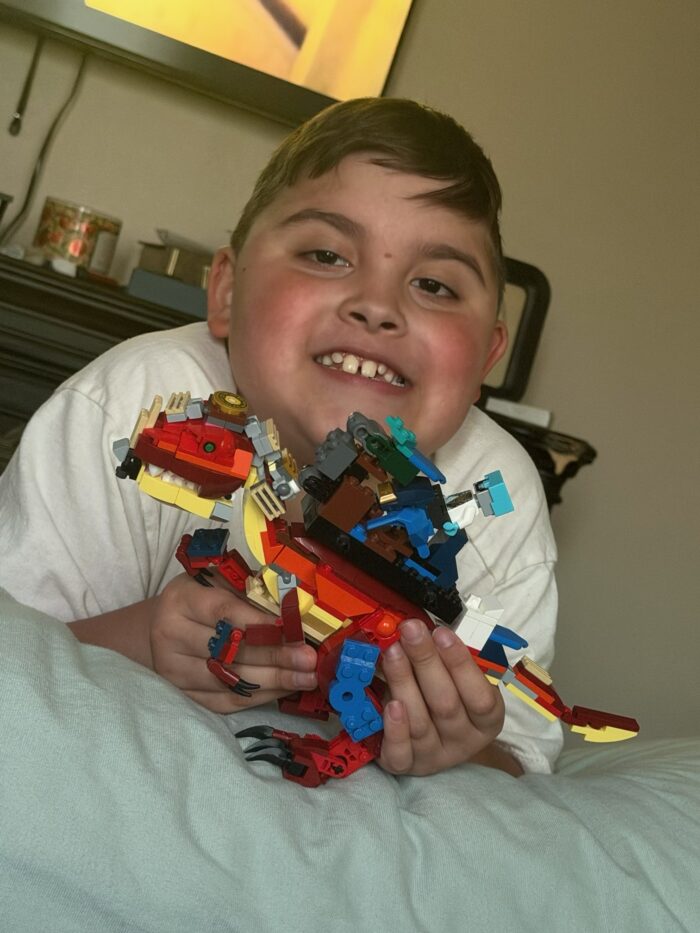
Mother and son were heading to Rady Children’s Hospital Orange County for an appointment.
It was March 31, 2026 — a big day for Rachel Dutton and Kyrian, 8.
“What are you going to be getting today?” Rachel asked her son.
“Super muscle juice,” he responded.
“How’s it going to help you?”
“I’m going to get strong.”
“What’s the first strong thing you want to do?”
“Run.”
Kyrian was on his way to the Dhont Family Foundation Infusion Center to receive — via a one-time, slow injection into a vein — a new gene therapy for Duchenne muscular dystrophy (DMD), which he was diagnosed with at 18 months.
Elevidys (delandistrogene moxeparvovec), the medication the Food and Drug Administration cleared in summer 2024 for use in kids 4 years of age and older, delivers into the body a gene that produces a protein that is present in normal muscle cells to treat the neuromuscular disorder, which leads to progressive muscle degeneration and weakness.
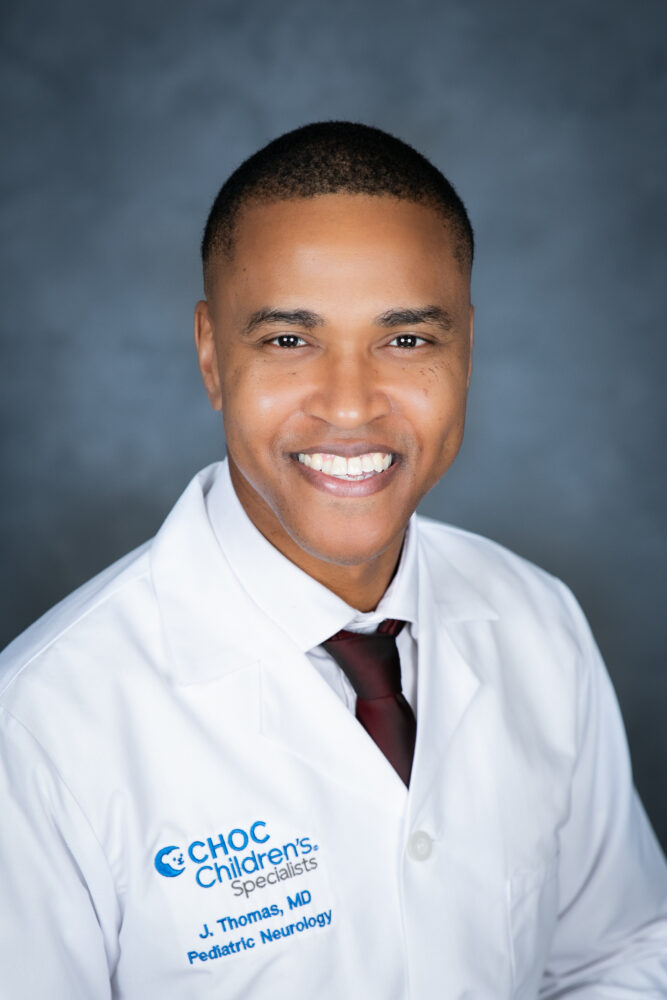
Pediatric neurologist Dr. Julian Thomas, who oversees oversees the CureDuchenne Clinic at Rady Children’s Hospital Orange County, administered the adeno-associated virus, vector-based gene therapy gene therapy to Kyrian over several hours.
The boy was the first patient in the region to receive Elevidys for DMD, says Dr. Thomas, who infused a second patient, also an 8-year-old boy, in April and has a third one lined up. Pediatric hospitals around the country are administering the therapy.
The Elevidys treatment potentially will last a lifetime, adds Dr. Thomas, who has a combination of clinical and teaching experience with interests in Duchenne muscular dystrophy, spinal muscular atrophy and clinical trials.
“Clinical studies have shown this therapy has substantial durability,” he says. “Stabilization has always been the goal, but some patients have shown improvement in their function and motor scores, which is not what is expected in the natural course of DMD with normal standard of care.”
Mostly affects boys
In the initial stages, DMD affects the muscles of the hips and thighs and the shoulder and upper arm muscles. These weaknesses lead to difficulty in rising from the floor, climbing stairs, maintaining balance, and raising arms.
DMD is caused by mutations to the DMD gene, resulting in deficient levels of the dystrophin protein. When functional, dystrophin helps keep muscle cells intact, and without dystrophin, muscle cells are vulnerable to injury, resulting in progressive muscle degeneration and weakness.
DMD symptom onset is in early childhood, usually between ages 2 and 3. The disease primarily affects males, though females can be symptomatic carriers, or in rare cases can be severely affected.
DMD occurs in approximately 1 in 3,500 to 5,000 male births.
Until the 2000s, boys with DMD usually did not survive much beyond their teen years. Because of improved guidelines recommending comprehensive multidisciplinary care, standardization of corticosteroid treatments, disease-modifying treatments, and advances in cardiac and respiratory support, life expectancy is increasing and many young adults with DMD attend college, have careers, get married, and even have children.
Survival into the early 30s, and even 40s, is becoming more common than before.
‘Astounded’ by small changes
For three months after receiving Elevidys, Kyrian returned to Rady Children’s Hospital Orange County weekly for a battery of bloodwork and testing to determine some attributes of his strength. Dr. Thomas also increased the dosage of corticosteroids he had been taking since he was 2.
Rachel has high praise for Kyrian’s care team.
“They have been there for me and him in ways I can’t even tell you,” she says. “When you have a team that is behind you, it gives you the wings you need.”
Jennifer Lee, RN, is Kyrian’s case manager.
“It has been a true honor to care for Kyrian and to walk alongside his family since he joined our CureDuchenne Clinic in 2022,” Jennifer says. “He showed remarkable bravery, and his family partnered closely with our team — diligently completing labs, therapy assessments, and treatment adjustments — to help him reach this milestone and continue support afterward.
“Since receiving gene therapy,” she adds, “we have learned of encouraging improvements in Kyrian that reflect its meaningful potential, and our team will continue to work together to maximize his strength, function, and overall well-being in the years ahead.”
Indeed, Rachel says she’s “astounded” by the small changes she’s seen in her son.
“The first thing I noticed was him picking up a gallon of juice from the floor and carrying it all the way to me,” Rachel says. “I had never seen him do that, certainly without struggling. And he only used one arm. He needs two arms to pick up most items.”
Getting into her sedan is also easier.
“Now he just hops in,” says Rachel. “He has struggled mostly with neck control and head strength, and now he’s much stronger. His fine motor skills also have increased quite a bit, and his handwriting is better – he’s not struggling as much with his confidence.”
Kyrian has experienced only mild side effects from the medication and has had no adverse reactions, Rachel adds.
From diagnostics to therapy
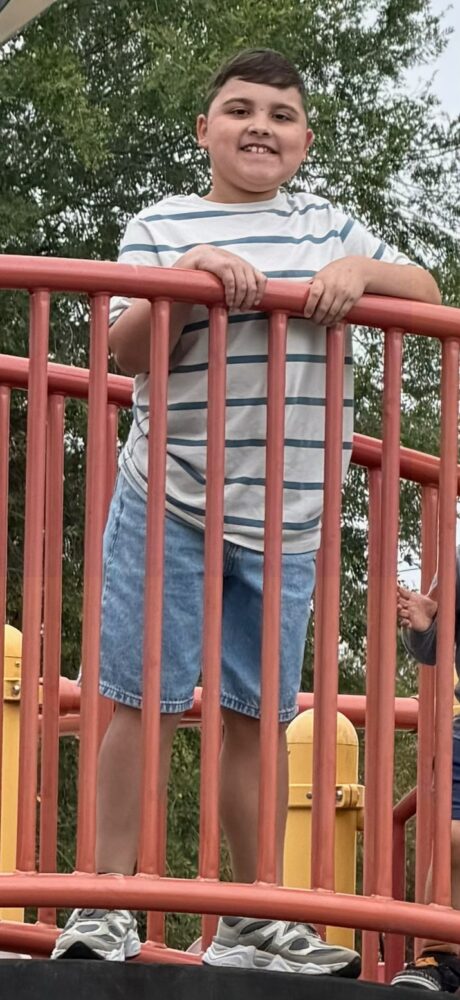
Kyrian, a fourth grader who loves science and math and logic and the “Minecraft” computer game, now is seeing Dr. Thomas every two weeks and is transitioning back to his normal corticosteroid dose.
In addition to Jennifer, pediatric neurologist Dr. Amanda Fernandez is part of the fledgling CureDuchenne Clinic, which offers three types of gene therapy treatments.
The Elevidys therapy is part of a push by Dr. Terence Sanger, chief scientific officer at Rady Children’s Hospital Orange County, to get Rady Children’s Health more involved in what he calls interventional genomics.
“At the end of the last millennium, gene therapy was in the era of diagnostics, and now we are in the age of genetics at therapies,” Dr. Sanger says. “There’s no point in diagnosing something you can’t treat and many of these genetic diseases do have treatments but there are many more that don’t.
“So, we have to be moving into this area because the genes in this type of disease are the cause so if you can fix the gene, you can fix the disease, and the earlier you can fix the gene, the better life these children have,” he adds. “The world I want to move toward is one where do a while genome sequencing on every newborn and fix everything we can. I want that world.”
Concludes Dr. Sanger: “I believe we’re moving into a world where treatment is going to much more about methods to fix your genetic mutation and less about drugs. To me, that’s what’s personalized medicine is. The excitement is we’re already doing this. There’s a lot around these therapies that is not just coming up with the drug. The actual administration of these things is complicated, there’s a lot of complex regulatory and safety stuff and outcomes measurements we do, because you need to prove it works and know the therapies that don’t work.
“This is not a simple process. You’re figuring out not just the drug but an entire medical procedure that makes sense for each patient and their families.”
Refer to a CHOC Pediatric Neurosurgery Specialist
Referrals can be placed online through the eCeptionist Referral Portal.