Cancer specialists at Rady Children’s Health Orange County, formerly called CHOC, have a long history of offering CAR T-cell therapy to children. The hospital began using the treatment in 2016 when it was initially only available for clinical trials. Children with refractory or multiple-relapsed B-cell acute lymphoblastic leukemia (B-ALL) comprise the primary group of pediatric patients receiving CAR T-cell therapy.
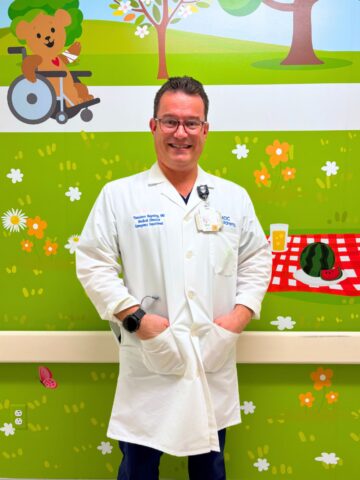
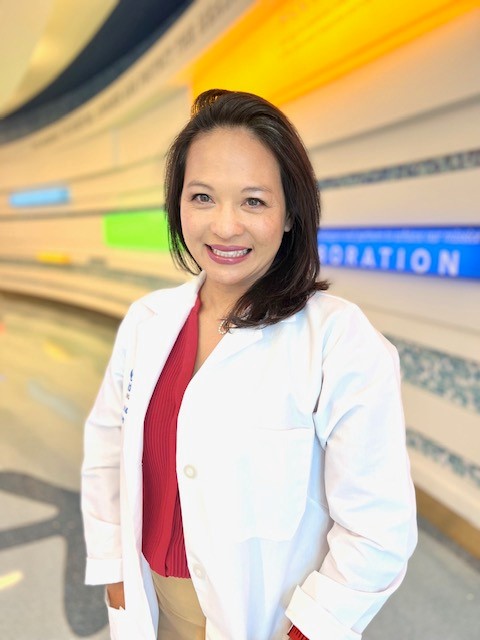
“Our site was able to offer CAR T-cell therapy for pediatric, adolescent and young adult patients with relapsed B-ALL before it became commercially available,” says Dr. Van T. Huynh, assistant division chief of the Division of Oncology, director of the Leukemia Program and section director of the CAR T-Cell Program at Rady Children’s, and associate clinical professor at the UC Irvine College of Medicine Department of Pediatrics. “Since then, we’ve been involved in multiple CAR T-cell clinical trials. Our early involvement in trials allowed us to develop the infrastructure and establish the best practices needed to expertly deliver CAR T cells before they became commercially available in 2017.”
A decade of advances
The Food and Drug Administration (FDA) approved the CAR T-cell therapy tisagenlecleucel for patients up to age 25 with refractory or relapsed B-ALL in 2017. Since then, Dr. Huynh says, the treatment has been “transformative.” It has significantly improved outcomes for these patients, many of whom have exhausted other therapies, including stem cell transplant. CAR T-cell therapy has given hope and extended survival for some children with advanced leukemia.
At Rady Children’s, patients and families find all the components necessary for successful CAR T-cell treatment.
“We offer clinical trials and FDA-approved CAR T-cell therapy for children, adolescents and young adults,” Dr. Huynh says. “We have the expertise and capacity to manage all the toxicities associated with CAR T cells and other immunotherapies. We provide the latest diagnostic testing and the benefit of highly trained cancer experts skilled in caring for patients receiving CAR T cells. Our multidisciplinary team provides comprehensive, patient-centered care.”
Identifying candidates for treatment
In addition to patients with refractory or relapsed B-ALL, CAR T-cell therapy may also be appropriate for some patients with lymphoma. According to Dr. Huynh, disease state, organ function and performance status are essential factors to consider when determining patients’ candidacy for CAR T-cell therapy.
“Other key factors include some of the toxicities associated with CAR T cells, such as cytokine release syndrome and immune effector cell-associated neurotoxicity syndrome,” Dr. Huynh says. “Fortunately, both are reversible.”
Once a patient is identified as a suitable candidate for CAR T-cell therapy, clinicians should promptly refer them to a specialized treatment center. Doing so, Dr. Huynh says, helps improve outcomes by allowing sufficient time for cell collection, manufacturing, insurance approval and logistical planning.
Groundbreaking gift
Despite reshaping care for some children with B-ALL, CAR T-cell therapy has not had a comparable impact on other types of leukemia, such as acute myeloid leukemia (AML). A new, first-of-its-kind lab at Rady Children’s aims to help change that.
In January 2025, Dr. Huynh received a $3.1-million gift from a philanthropic donor to expand the clinical Cancer Immunotherapy Program and lay the groundwork necessary to establish a CAR T-cell laboratory. She will continue to pursue additional funding opportunities to build up the program. Working in the new Southwest Tower research space that was recently built, Dr. Huynh and her team will investigate the potential of CAR T-cell therapy to treat children with AML.
“The survival rates for patients with refractory or relapsed AML are abysmal, leaving a critical, unmet need to find the optimal therapy for this often heavily pretreated population,” Dr. Huynh says. “As a result, the initial focus of our new CAR T-cell lab will be on the development of a novel CAR T target for AML. Additionally, we aim to understand AML tumor biology because there are currently significant obstacles to developing AML CARs.”
Those obstacles range from antigen escape and a dearth of AML-specific antigens to challenges in collecting patients’ T cells and manufacturing the therapies. As the new lab at Rady Children’s works to solve those challenges, its goal, Dr. Huynh says, is to develop an effective AML CAR and take the therapy from bench to bedside through clinical trials.
Working to bring CAR T-cell therapy’s promise to fruition
The establishment of Rady Children’s’ CAR T-cell therapy lab positions the hospital to help lead the way in exploring the treatment’s full potential.
“The success of CAR T-cell therapy in B-ALL and lymphoma has paved the way for researchers to extend the use of cellular engineering therapies to other subtypes of ALL, AML and solid tumors, such as neuroblastomas and aggressive brain tumors,” Dr. Huynh says. “Recent preliminary data have also shown encouraging results for the use of CAR T-cell therapy to treat autoimmune diseases, such as lupus. As a result, this therapy has the potential to transform how we treat a variety of diseases, and it also has the unique promise of being a one-and-done treatment with curative potential.”
Learn about the Hyundai Cancer Institute at Rady Children’s Health Orange County, formerly called CHOC, where patients have access to the most advanced therapies under study as part of the institute’s membership
Learn more about cancer research and clinical trials at CHOC