
A new national study led by Rady Children’s Health Orange County, formerly called CHOC, that examined e-bike injuries suffered by pediatric patients during a five-year period highlights the risks associated with speeds higher than 20 MPH and the need for targeted safety measures and legislation, especially related to the prevention of head injuries.
The study, the first to look at speed factors and e-bike injuries in children and teens, comes as e-bike-related trauma visits to pediatric emergency departments continue to sharply increase nationally including at Rady Children’s.
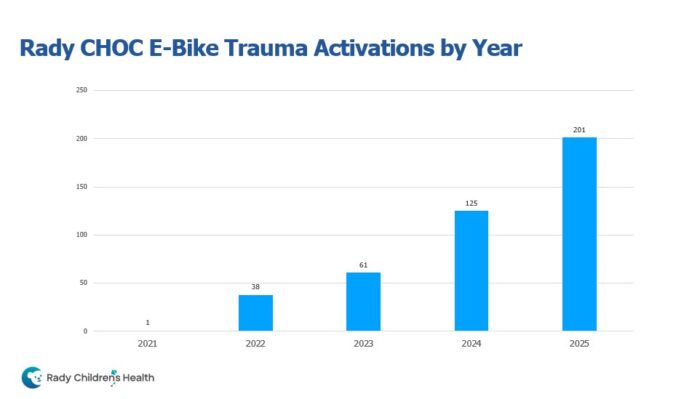
In 2025, the ED at Rady Children’s saw 201 such trauma patients, compared to 125 the year before.
In 2021, there was only one.
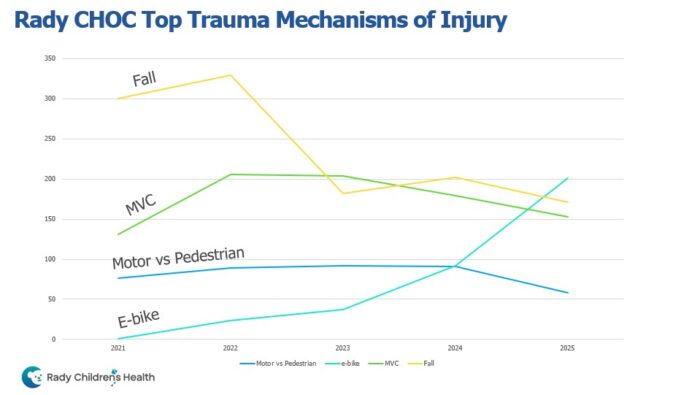
Also in 2021, falls were by far the top cause of Rady Children’s ED trauma patient visits, followed by motor vehicle collisions and car-vs.-pedestrian collisions.
In 2025, e-bike injuries surpassed all of those to become the No. 1 reason for ED trauma visits at Rady Children’s.
“We basically have kids riding vehicles that are much more like motorcycles than bicycles, and many of them have not taken a class on how to ride them safely and don’t know the rules of the road,” says study leader Dr. Laura Goodman. “It’s a big problem.”
Timely national data
The retrospective study, which involved sample probability, provides timely national data showing increasing injury rates and a link between higher speeds and more severe injuries, including hospitalizations.
With limited national data on the epidemiology of e-bike related injuries sustained by children and teens, the research underscores Rady Children’s’ leadership in pediatric trauma research and, as Orange County’s only level 1 pediatric trauma center, its commitment to injury prevention and turning research into practical safety guidance.
For the study, published Dec. 4, 2025, in the journal Injury, Dr. Goodman and nine other researchers examined e-bike injuries recorded between 2019 and 2023. The data came from the National Electronic Injury Surveillance System that is collected by the Consumer Products Safety Commission.
The study cohort consisted of 437 e-bike patients who were estimated to represent 15,121 pediatric patients with injuries related to e-bikes. Over the five-year period, the frequency of e-bike injuries showed a dramatic increase, with 4.2% occurring in 2019 and nearly 50% in 2023.
Injuries related to speed were associated with a higher incidence of head, neck, or facial injuries (49.1% vs 28.7%) compared to injuries resulting from other causes.
A greater proportion of children with speed-related injuries sustained internal organ injuries (24.1% vs. 10.4%) and were admitted to the hospital (7.3% vs. 4.7%). Of those injuries specified as internal, 96.7% were head and neck injuries compared to 3.3% to other parts of the body.
A solid foundation
“It’s kind of intuitive: The faster you’re going on an e-bike, the more the force of the crash and the more internal injuries that necessitate hospital admission,” says Dr. Goodman, pediatric general and thoracic surgeon and trauma medical director at Rady Children’s who also serves as a vice-chair on the Southern California chapter of the American College of Surgeons’ Committee on Trauma.
“The baseline data in this study,” Dr. Goodman adds, “gives us a strong foundation from which we can say, we really need to take stock of which types of e-bikes kids are riding and make sure they’re legal for their age and make sure parents know what kinds of bikes their kids are riding and how they can regulate their speeds from an app or other ways to try to keep their kids safe, as well as how they can educate their kids whether online or in person about e-bike safety and training courses.”
Among Dr. Goodman’s collaborators were Dr. Romeo Ignacio, a pediatric surgeon at Rady Children’s Hospital-San Diego, and Dr. Zoe Flyer, a fellow at Rady Children’s who is taking a couple of years out of her general surgery training to conduct research.
The study was presented at the Pediatric Trauma Society conference in 2024 and at Research Day 2024.
“One of the more important takeaways from this study is that we are seeing far more internal injuries with e-bike crashes,” Dr. Flyer says. “While we weren’t able to discern from our data more specifically what types of internal injuries more patients are experiencing, they can be serious and they often can be missed.
“This study speaks to the severity of injuries we’re seeing in pediatric patients who are very vulnerable, and it might be difficult to detect these injuries at first glance, but we need to do our due diligence in working these patients up to make sure we’re not missing any of these internal injuries.”
Dr. Goodman recently treated a patient in the ED who complained of persistent abdominal pain from an e-bike crash several days prior. After running tests, she found he had suffered a splenic injury.
“Luckily, he had stabilized by the time I saw him,” Dr. Goodman says. “But spleen injuries can cause persistent bleeding, and a patient can get into real trouble if they aren’t taken care of.”
Adds Dr. Flyer: “When a person crashes on a bicycle, as opposed to a motorcycle, they often don’t go to the ED. I think there’s now a fine line between e-bikes and motorcycles.”
More studies in the works
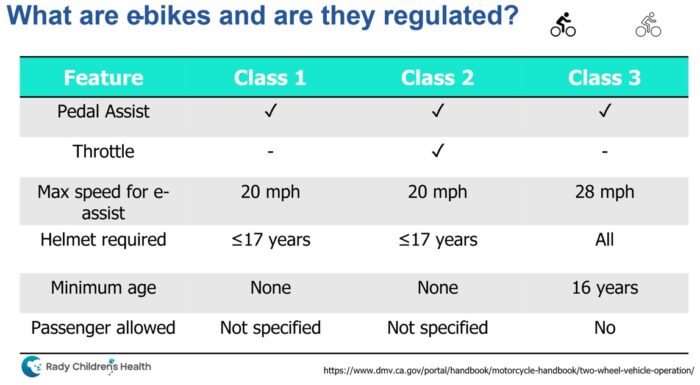
Dr. Goodman was the lead author of a 2023 study that identified e-bikes as an increasingly common pediatric public health problem.
More Rady Children’s-led e-bike injury studies are in the works, including one that will build on Dr. Goodman’s latest study that will address such issues as the prevalence of helmet use and traumatic brain injuries.
Meanwhile, a major interdisciplinary effort between Rady Children’s neurosurgery, pediatric surgery, and orthopedic surgery divisions is under way to more thoroughly study all e-bike related injuries seen here over the past five-plus years, says pediatric neurosurgeon Dr. Aaron Yengo-Kahn.
“E-bikes continue to present a major injury risk for teenagers,” Dr. Yengo-Khan says. “Anecdotally, we find that traumatic brain injury occurs more frequently with e-bike accidents and to a greater severity. Therefore, we’re looking to investigate that hypothesis more thoroughly.”
Dr. Ignacio Mesina-Estarron, a postdoctoral research fellow in Rady Children’s department of neurosurgery, is planning and executing that study.
“We want to build on the trauma/ED team’s work,” Dr. Mesina-Estarron explains. “Their research team adheres to the American College of Surgeons’ national standard for data collection for all trauma cases that receive clinical care at Rady Children’s. That’s important because it lets us accelerate research by accessing high-quality data more quickly and consistently.”
Dr. Mesina-Estarron says he and others involved in the study have reason to believe e-bikes are linked to more severe injuries and potentially a more prolonged recovery compared with regular bikes.
“As a bike commuter myself, I’ve visited many bike shops in the area, and it’s striking how many people, including teens, are coming in asking for e-bikes and e-scooters,” Dr. Mesina-Estarron says. “Recent California regulations related to speed limits seem like a step in the right direction, but we’re curious to see whether they have any measurable impact on the volume and severity of cases — not only at Rady Children’s but in all pediatric hospitals.”
Illegal e-bikes
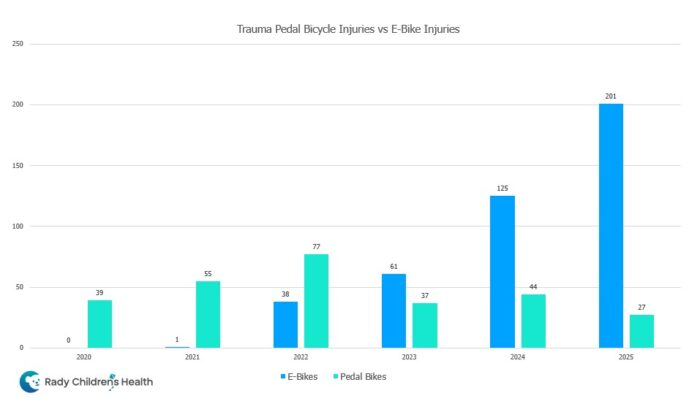
California has introduced stricter safety regulations and has clarified the classification of e-bikes as their popularity has soared:
- Class 1 e-bikes are limited to 20 MPH on pedal assist, with no throttle operation.
- Class 2 e-bikes can reach 20 MPH with a throttle, but not without pedaling.
- Class 3 e-bikes can reach 28 MPH on pedal assist but must include a speedometer and cannot use a throttle. Passengers are not allowed on Class 3 e-bikes.
- Riders must be at least 16 years old to ride a Class 3 e-bike and helmets are required for all riders, regardless of age or e-bike class.
But illegal, over-powered devices are a key problem, according to a December 2025 report by the Mineta Transportation Institute (MTI) at San Jose State University (SJSU).
While nobody knows how many of these illegal electric bicycles are on the road, the percentage might be quite high, the MTI study found. Counts of electric two-wheelers parked at a dozen northern California middle and high schools found that almost 90% may not meet the standards for legal electric bicycles. Some of these devices have as much as eight times more power than legal limits.
In the December 2025 study, MTI recommended revising the way the California Vehicle Code defines and regulates electric bicycles, opportunities for improving electric bicycle safety data quality and analysis, building safe infrastructure for e-biking, and public education on electric bicycle rules of the road and safe riding practices.
Rady Children’s is involved intrying to help parents understand what type of e-bikes their children have and the top speeds, with current work underway to define e-bike types to help inform researchers what type of e-bike was involved in a crash, Dr. Goodman says.
Rady Children’s will use this information in a national study led by Dr. Goodman through the A+ Pediatric Trauma Research Network, which has more than 30 different member hospitals.
Meanwhile, an ED fellow at Rady Children’s, Dr. Saxony Busta, is surveying parents and caregivers in the ED waiting room to determine parental perception of e-bike safety for their children. The survey also assesses parental reports of helmet use on e-bikes and assesses familiarity and research completed by parents prior to purchasing e-bikes for their children.
“My goal is to use this study to inform advocacy and injury prevention for children riding e-bikes,” Dr. Busta says. “We know more and more kids are riding e-bikes and sustaining injuries while doing so. This study will help us understand where parents are so we can educate families and ideally prevent further e-bike injuries.”
Prevention tips
Makenzie Ferguson, RN, BSN, injury prevention coordinator for Rady Children’s’ trauma program, notes that the goal isn’t to discourage the use of e-bikes but to make sure riders understand the risks and know how to protect themselves.
Based on what the trauma care team is seeing locally and through recent research, there are several important steps riders and families can take to help reduce that risk, Makenzie said:
- Get informed. Parents and teens should take time to understand the different classes of e-bikes and the laws in their community.
- Take a class. Many law enforcement agencies in Orange County now offer hands-on e-bike safety courses specifically for teens.
- Wear a helmet. A properly fitted and buckled helmet is one of the most effective ways to reduce the risk of serious head injury.
- Think about age. Most safety experts agree that children under 12 should not be riding e-bikes due to speed, size, and handling challenges.
- Do not modify e-bikes. Altering an e-bike can increase speed and change how it is classified under the law, sometimes requiring a license and different safety equipment.
“Unfortunately, injury prevention doesn’t happen overnight,” Makenzie said. “Historically, it can take five to seven years for injury rates to decline as laws, infrastructure, and helmet standards (especially those designed to withstand high-impact crashes) catch up with new technology like e-bikes.
“Until then, my message to families is simple: learn the rules of the road, ride responsibly, and always wear a helmet,” she added.
Visit the California Highway Patrol online e-bike course Vulnerable Road Users
Learn about the latest state legislation concerning e-bikes
Catch up on other e-bike related material here at E-Bikes – Orange County Transportation Authority
Learn more about emergency and trauma services at CHOC