In the world of rare diseases, every journey often begins in isolation, but it doesn’t have to stay that way. Through collaboration, compassion, and an unwavering commitment to progress, Rady Children’s Health in Orange County, formerly called CHOC, and UC Irvine are building a connected community where no one feels rare, and no one walks their path alone.
Since being designated a NORD Rare Disease Center of Excellence in 2021, Rady Children’s Health and UC Irvine have advanced rare disease research, care, and collaboration. This recognition honors institutions excelling in multidisciplinary care, innovative research, and meaningful engagement with the rare disease community.
Building on this, the institutions have co-hosted five consecutive Rare Disease Symposiums (2022–2026), timed with Rare Disease Day (Feb. 28), to bring together clinicians, researchers, patients, families, and industry partners — fostering awareness, equity, and progress in rare disease diagnosis and treatment.
This year, Rady’s Children’s Health and UCI brought together three essential forces in rare disease research, community, and industry. Nearly 350 participants came together both in person and virtually, from Orange County and across the country. What began as a local gathering has grown into a broader, more connected community. Organizers also expanded their commitment to patient and family engagement, supporting travel awards to ensure that community voices could be present. Hearing their stories reminded us why this work matters.
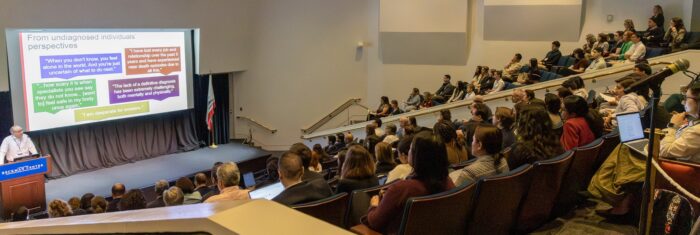
Advancing rare disease care: insights from leading experts
This spirit came to life through the featured sessions, each representing a critical step along the rare disease journey from unanswered questions to transformative care. The day began with Dr. Jonathan Bernstein from the Stanford Center for Undiagnosed Diseases, who illuminated new pathways to diagnosing rare genetic conditions, bringing long-awaited answers and renewed hope to patients and families.
Dr. Matthew A. Deardorff (CHLA) addressed one of the field’s most pressing challenges: translating rare diagnoses into meaningful, life-changing treatments and highlighting the vital bridge between discovery and impact.
The symposium included Dr. Olivia Kim-McManus (UCSD) who showcased the promise of precision medicine through investigational antisense oligonucleotides for developmental epileptic encephalopathies, demonstrating how cutting-edge science is increasingly tailored to the individual.
The symposium concluded with Dr. Manish J. Butte (UCLA), who presented innovative strategies for treating immune dysregulation and gain-of-function disorders, emphasizing the importance of targeted therapies in complex conditions.
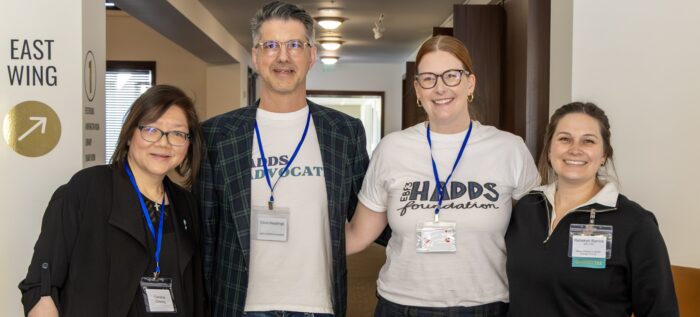
No longer a mystery: Families share their journeys
During the family panel session, families took the stage to share their personal experiences navigating rare diseases. Caroline Cheung recounted her family’s path to diagnosis, emphasizing the power of togetherness:
“It is a shared responsibility of physicians, registries, researchers, industry, and families to move a rare disease patient forward in their complex care journey,” Caroline said. “Rare disease may begin with a mystery, but it doesn’t have to end in isolation. When families, clinicians, and researchers come together, uncertainty becomes understanding.”
Similarly, the Christopher and Margot Headings shared their journey with HADDS, offering a heartfelt look at the challenges and triumphs of rare disease care.
“The single most important piece is finding your community — it is everything,” Margot said. “To any family starting out, hold on: You are not alone. The wait does get easier, and your child will amaze you in ways you cannot yet imagine.”
All these stories highlighted the resilience and hope of families navigating rare conditions, while demonstrating the power of collaboration in advancing research and care. They also reflect the Research Institute’s commitment to driving meaningful progress, creating opportunities for partners and supporters to help accelerate discoveries and bring life-changing treatments to patients faster.
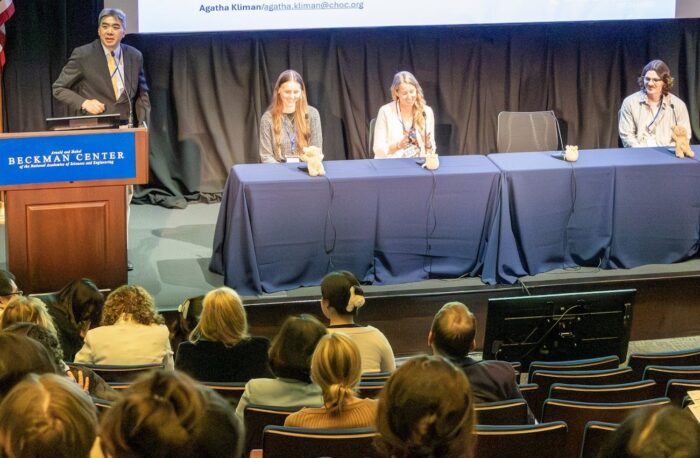
Outstanding scientific contributions
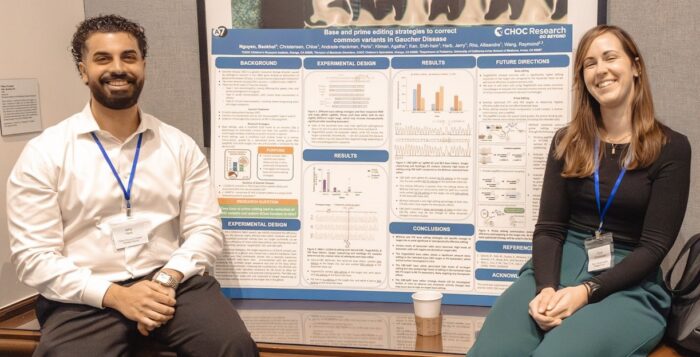
The 2026 Rare Disease Symposium also celebrated outstanding scientific contributions through its poster competition and a series of mini podium presentations.
Mini podiums included:
- Hollingsworth, Ethan (UCI) Poised Chromatin Restricts and Informs Noncoding Variant Pathogenesis in Rare Human Disease
- Wigby, Kristen (UCSD) Genomic Sequencing for Undiagnosed Neurological Disorders: The Rady Children’s Precision Medicine for Rare Disease Program
- Kliman, Agatha (Rady Children’s OC) Creation of a GBA1 cell model harboring the c.1448T>C pathogenic variant for optimization of prime editing strategies
Posters
- Boock, Victoria (UCI) Glycogen synthase (GYS1) antisense oligonucleotides reduces glycogen effectively in the neonatal Pompe disease mouse model.
- Milo, Sydney (Rady Children’s OC) The effect of increased pressure on neural stem cell differentiation and implications for ventricular zone genesis
- Sugita, Kyle (UC Riverside) Preventing the Preventable: PONV Prophylaxis and Outcomes in Patients With Pulmonary Arterial Hypertension
Learn more about metabolic rare disease research at CHOC