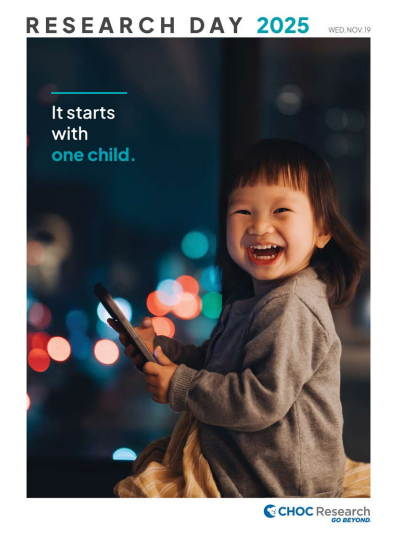
Capping a historic year in which it expanded into a state-of-the-art new home, the Research Institute at CHOC, part of Rady Children’s Health, celebrated the innovation, dedication, and discoveries of its researchers at Research Day 2025, held on Nov. 19.
This year, half of the annual day-long event – attended by scientists, clinicians, trainees, staff members, and others — was held in the institute’s new space that takes up the entire ninth floor of the new Southwest Tower, which opened in June.
The other half of Research Day featured panel discussions that could be seen online or in person in the Wade Education Center on the Orange campus.
The theme of this year’s Research Day was “It Starts With One Child.”
A pivotal moment
In her comments in the official program, Kimberly Chavalas Cripe, co-president and chief executive officer of Rady Children’s Health, noted: “Every question we ask, every study we undertake, and every breakthrough we pursue begins with a single patient – the child whose story sparks curiosity, inspires discovery, and drives progress.”
There are 655 active studies within the CHOC Research Institute, which employs 166. Nearly 3,500 patients are enrolled in clinical trials.
Dr. Terence Sanger, vice president and chief scientific officer, said the Research Institute stands at a pivotal moment in its evolution, building on five years of infrastructure development to expand its vision and establish world leadership in pediatric research.
The institute’s new FY26-FY30 strategic plan, “The Path Forward,” sets a bold course for the next five years, Dr. Sanger said.
Details of new home
Spanning nearly 29,000 feet, the Research Institute’s new home marksthe first time in the history of the pediatric healthcare system’s Orange campus that research has dedicated space for seeing participants for study-specific outpatient procedures.
The ninth floor of the Southwest Tower has two key service areas.
Basic and translational laboratories take up two-thirds of the floor. The space has 46 lab benches for scientists to seek new or improved drugs, devices, or diagnostics. Key features of the lab area include the centrifuge core, flow cytometry core, histology core, and microscopy core. There also are clean rooms for the development of cell and gene therapies and a Maker Space where high-tech 3D printing will enhance researchers’ abilities to create and innovate.
The Center for Clinical Research, a licensed multispeciality clinic, allows study participants to be seen in space designed to support study-specific visits. There are four exam rooms, four consultation rooms, and one observation room supporting diverse clinical protocols. There is also a Human Performance Laboratory for gait and motion analysis and exercise physiology, as well as an Exploratorium to stimulate interest in STEAM (science, technology, engineering, art, math) activities. The Center for Clinical Research also features three large circular windows through which patients and families can look into the basic and translational laboratory room.
Future displays will include activities and STEAM Explorers, a monthly production collaboration produced by the Research Institute and Seacrest Studios.
Pre-Research Day events
Prior to Research Day, the Research Institute organized two workshops for new researchers: “Poster Preparation Tips & Tricks Session” and an “Early Career Researcher Preparation and Networking Event.”
The “tips and tricks” session was an interactive workshop that provided early-career researchers with practical strategies for designing clear, compelling, and scientifically rigorous research posters.
Through real examples, visual demonstrations, and guided discussion, participants learned the key components of a professional poster, effective layout and formatting principles, and how to communicate findings concisely.
The session also introduced Research Day submission requirements and available institutional resources to support poster development. Pre- and post-session surveys assessed participants’ confidence in poster design skills, awareness of formatting guidelines, and readiness to apply new techniques.
At the networking event, held the week before Research Day, early-career researchers were provided an opportunity to build community, deepen their understanding of Research Day coordination, and engage directly with experienced CHOC investigators.
The evening included a welcome from Research Institute leadership, a step-by-step walkthrough of day-of expectations, two short research presentations modeling high-quality scholarly activity, and a facilitated mentor networking session.
Small-group conversations allowed trainees to discuss scholarly interests, receive personalized guidance from esteemed mentors, and strengthen their sense of belonging within the research community. Pre/post surveys measured confidence in navigating Research Day, understanding scholarly expectations, and connecting with mentors.
Anna Le, a B.S. candidate in psychology, biological sciences, and political sciences at UC Irvine, said the Early Career Researcher Preparation and Networking Event was “incredibly valuable in demystifying the Research Day process while also fostering a genuine sense of community.”
She added: “Hearing directly from experienced researchers and physicians helped me understand what to expect and feel more prepared for presenting my work. It was also a great opportunity to connect with mentors across a variety of fields and learn more about potential research pathways. Overall, I left the event feeling more confident.”
Together, the tips and tricks and early career researcher preparation sessions provided a comprehensive framework that improved participants’ confidence, increased readiness for dissemination of high-quality research, and fostered meaningful connections across the research community.
Research Day morning sessions
Two panels were held in the morning sessions of Research Day.
Before the panel discussions, Dr. Coleen Cunningham, senior vice president and pediatrician-in-chief at CHOC and professor and chair of pediatrics at UC Irvine, delivered opening remarks and welcomed guests.
“Research Day is both a celebration and a call to action,” Dr. Cunningham said. “We’re thrilled to highlight the depth and impact of our research efforts while also sharing a dynamic platform for connection and collaboration.”
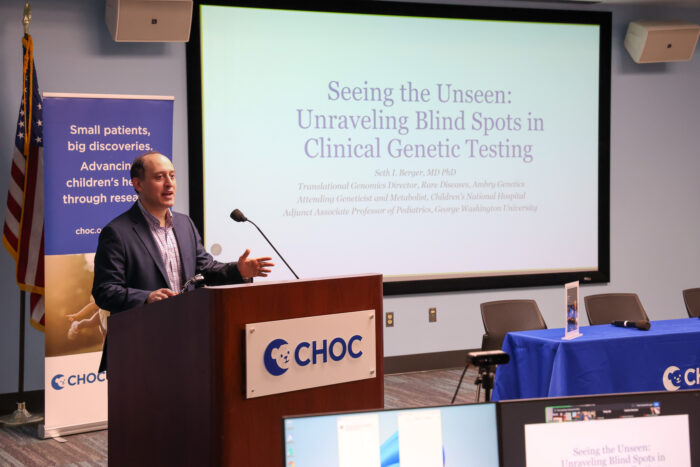
Dr. Seth I. Berger, translational genomics director for rare diseases research and development at Ambry Genetics in Aliso Viejo, delivered the keynote address, “Seeing the Unseen: Unraveling Bling Spots in Clinical Genetic Testing.”
Berger, a physician scientist, shared how advancements in genomic technologies and informatic approaches are helping move beyond limitations in current testing to help in the diagnosis of rare diseases.
He detailed several patient cases that helped achieve diagnoses and, in some cases, treatment for children.
Two key points Berger made were that “negative” genetic tests are not always negative and that long-read genomes and transcriptomes offer many new ways to reach previously unreachable genetic diagnoses.
“Every child here has their story to share,” Berger said.
First panel discussion
Dr. Mustafa Kabeer, a pediatric general and thoracic surgeon at CHOC, moderated Panel 1, “The Spark of One: How a Single Patient Inspires Innovation.”
The panelists were Louay Fakhro, chief executive officer and founder of Omaroon, a medical device company in Mission Viejo, and Dr. Sharief Taraman, a pediatric neurologist at CHOC and a health sciences professor at UCI.
“Discovery, insight, and innovation all fall under the umbrella of research,” Dr. Kabeer said. “For many of us, all of these changes and advances in our world happen because of things like this.”
The aim of the panel was to discuss the spark of one – how a single patient can spark innovation.
Dr. Kabeer shared the story of a recent newborn patient he treated for esophageal atresia – when the esophagus has two separate sections (upper and lower) that don’t connect. With a single suture, he was able to correct the problem, and the patient went home after 2 ½ months for a birth defect that usually requires several surgeries and a year in the neonatal intensive care unit.
Dr. Taraman discussed how he developed a brace called the Move-D to treat a teen, Dylan, whose hands shook because of cerebral palsy. Dylan provided insight that led him to become co-inventor of the device with a team of biomedical engineering students at UCI who used human design principles in creating the brace.
Dylan enjoyed a 50% improvement in using his arms and hands when using the Move-D brace, Dr. Taraman said.
“The reality is if we don’t dream big, we can never see the big idea that comes,” he said. “A lot of times, you have to be a little unrealistic to drive innovation. So, don’t be afraid to dream big.”
Fakhro told the story of his son who needed, after birth, vitamin supplements to support healthy brain development. His son had phenylketonuria (PKU), a rare genetic disease that occurs due to the lack of an enzyme that helps their bodies break down a specific amino acid. Without this enzyme, the amino acid builds up in the blood and brain. It can cause toxic effects without treatment. Treatment includes a special diet and medication.
Fakhro’s company is developing a home-based device whose goal is to revolutionize PKU management, improving quality of life for patients worldwide.
“This would not have happened without a caring physician and a child in need,” Fakhro said.
In the panel discussion, Dr. Taraman advocated for whole genome sequencing for every child that is hospitalized and the use of AI to crunch the numbers of huge databases in the quest to identify and treat rare diseases.
Noted Fakhro about the important of pursuing innovation: “One thing is certain: Do not accept the status quo. If there’s something not working is that because it’s physically impossible or because of constraints in the system how things operate, and if you change the system will things improve?”
Second panel discussion
Dr. Raymond Wang, a biochemical geneticist and director of the Campbell Foundation Multidisciplinary Lysosomal Disorder Program in the division of metabolic disorders at CHOC, moderated Panel 2, “From Genes to Care: Interventional Genomics in Pediatric Medicine.”
The panelists were pediatric oncologist Dr. Van Huynh and Dr. Diane Nugent, medical director of pediatric hematology at RCH in Orange.
Dr. Wang detailed his 18-year research journey at CHOC and said a team approach is critical to getting the job done as well as not simply accepting the standard of care but pursuing new treatments with “grit.”
He emphasized the importance of his relationship with patients and families and shared a couple of patient stories. One of his patients has Hurler Syndrome, the most severe form of mucopolysaccharidosis type I, a hereditary lysosomal storage condition.
Kids with this disorder have cells that can’t break down sugar molecules, which affects how they function. Symptoms are life-threatening and treatment increases life expectancy.
Dr. Wang treated the patient with gene therapy. The child is now 8 and a second grader, and is progressing “quite well,” he said, adding that the boy is a perfect example of not simply accepting the standard of care.
Dr. Nugent arrived in 1993 when CHOC had little research going on except for some oncology studies.
She praised CHOC for building up a research program and thanked Phuong Dao, executive director, research institute, for her leadership and for building the infrastructure that allowed for dramatic growth of the institute.
Dr. Nugent mentioned the 20-year journey that culminated two years ago with the first gene-therapy treatment for a patient with hemophilia at the CHOC-affiliated Center for Comprehensive & Diagnosis of Inherited Blood Disorders (CIBD), a non-profit Dr. Nugent founded 15 years ago.
The CIBD became the first hemophilia center in the country to administer a commercial gene therapy infusion to treat Hemophilia A, the most common type of the disorder that affects 33,000 males in the U.S.
“Patients come to CHOC because they don’t just want treatment, they want cure,” Dr. Nugent said. “And that’s what researchers here are doing. Don’t leave here thinking that you’re not part of a much bigger picture. We couldn’t cure kids without the work you’re doing.”
Dr. Huynh, who has participated in several groundbreaking CAR-T cell clinical and research trials and is medical director of CHOC’s leukemia program, discussed the evolving landscape of cancer therapy in pediatrics and adolescent young adults.
“I have seen such incredible growth in research at CHOC,” Dr. Huynh said. “I feel we’re at the cusp of something great, and at the end of the day, it’s our patients who will benefit.”
Precision medicine, immunotherapy, advances in cancer genomics, and complex multi-agent, multimodal approach regimens and among several reasons why more kids are surviving most cancers than they did five decades ago – some dramatically, depending on the type of cancer they have, Dr. Huynh noted.
Afternoon sessions
During the afternoon of Research Day, Carol Davis-Dao, PhD, moderated eight podium presentations. The topics ranged from cognitive variability in youth with obstructive sleep apnea to the use of electroacupuncture to manage neuropsychiatric symptoms and adolescent and young adult cancer patients and survivors.
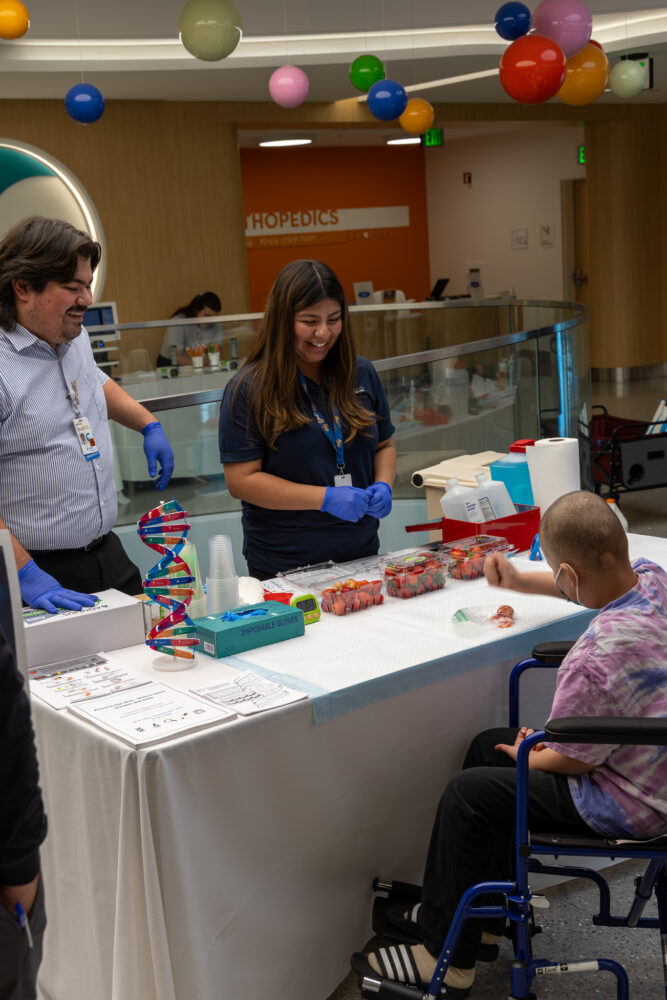
The afternoon also included, on the second-floor lobby of the Southwest Tower, “Science Quest,” a collection of scientist skill drills designed for children. Activities included a strawberry DNA extraction activity, a magnification and microscopy display, information about the field of marine biology, a serial dilution activity, and making colorful slime by following a scientific protocol.
Also, a second-annual egg drop competition was held on the second-floor lobby of the Bill Holmes Tower. For this challenge, various departments designed and built a shipping container to prevent a raw chicken egg from breaking when dropped. The challenging activity involved physics, engineering, and creativity.
The neurology department won the egg drop competition.
During the afternoon session, attendees also were able to view 70 poster presentations and converse with the presenting authors.
The winners of the poster competition were:
Poster # 2: Aubrey Gibson (undergraduate student) – Multicenter Analysis Confirms that Ultrasounds in the First Two Days of Life Underestimate Severity of Hydronephrosis
Poster # 7: Tiffany Huang (graduate student) – Cost Analysis of Managing Low-grade Hydronephrosis During the First Two Days of Life
Poster # 23: Lauren Burnett (DO, oncology, UCLA) – Comparative Outcomes of Haploidentical vs. Matched Sibling Donor Hematopoietic Stem Cell Transplantation in Pediatric Acute Lymphoblastic Leukemia
Poster # 27: Amirhossein Shahriari (CHOC Research Institute) – Reducing Cellular Adhesion on Shunt Catheters Using Zwitterionic Surface Modification: A Bioreactor-Based Study
Poster # 50: Kalysa Bui (undergraduate student) – How Does Sleep Quality Affect Emotional Regulation and Daily Mood in Pediatric Patients With and Without Sleep Apnea?
Poster # 54: Hafiz Muhammad Umer Farooqi (Metabolic Disorders lab, CHOC) – Developmental and Behavioral Characterization of Ndufs4 Mutant Mice
Poster # 66: Anna Le (undergraduate student) – Comprehensive Assessment of T-cell Exhaustion in Allogeneic HSCT and CAR T-cell Immunotherapy

Learn about pediatric research and clinical trials at CHOC