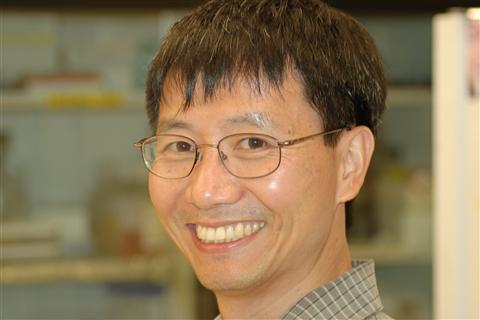
Shengwen Calvin Li, PhD, M.Phil., FRSB, FRSM, staff scientist II/principal investigator at the Research Institute of Rady Children’s Health Orange County, has long oriented his research using a specific philosophical North Star. His idea: that “cancer is not a static genetic disease — it is a dynamic biological ecosystem that continuously evolves under therapeutic pressure.” Findings from a recent study validate that notion and have the potential to change cancer care for pediatric and adult patients alike.
Establishing a hypothesis: rethinking genetic sequencing
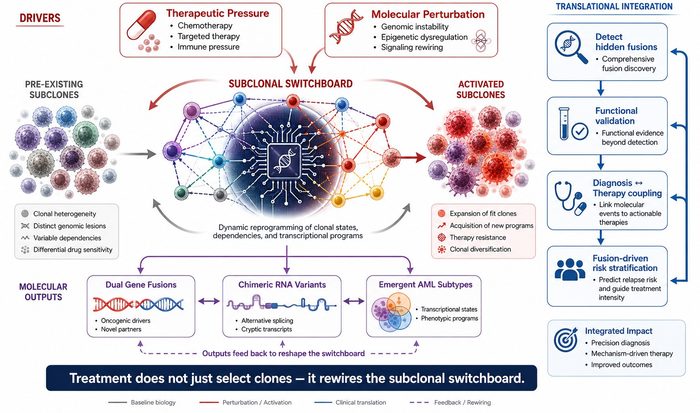
In a 2012 paper in Stem Cells and Development, Dr. Li introduced the concept of the Subclonal Switchboard, a framework that reflects his philosophy about cancer’s dynamism.
“We wanted to develop a comprehensive platform capable of discovering previously unknown genetic drivers of treatment resistance while simultaneously translating those discoveries into clinically actionable information,” Dr. Li says. “To accomplish this, we developed the Subclonal Switchboard Precision Oncology Platform™, or FusionSwitch™ for short, an integrated molecular discovery and precision medicine framework.”
FusionSwitch, Dr. Li says, integrates transcriptome-wide RNA sequencing with conventional cytogenetics, PCR, Sanger sequencing, quantitative PCR, functional validation and computational analytics. As a result, it extends the ability of standard diagnostic tests to detect previously hidden genetic abnormalities.
Applying genetic sequencing to treatment-resistant disease
Fourteen years later, Dr. Li and his team put those findings to use to follow patients with AML that featured a specific chromosomal rearrangement, KMT2A. Many patients with AML initially achieve remission following chemotherapy and then, eventually, relapse. Often, Dr. Li says, the relapsed leukemia is different than what patients started with.
“The relapsed disease reflects an evolving diagnosis in which treatment itself reshapes the genetic and biological landscape, allowing previously rare or therapy-resistant subclones to expand,” he says. “Understanding these evolutionary processes is therefore essential if we hope to improve long-term outcomes.”
AML that features rearrangement of the KMT2A gene is more likely to relapse. In a 2025 study published in Drug Resistance Updates, Dr. Li and colleagues identified a previously unrecognized CCDC32/CBX3 fusion gene in a young adult with KMT2A-rearranged AML who experienced relapse.
“In our index patient, the CCDC32/CBX3 fusion persisted from diagnosis through relapse, even while other molecular features changed during treatment,” Dr. Li says. “This observation suggested that the fusion was part of a stable molecular program accompanying disease evolution rather than a transient genetic event. At the same time, we observed dynamic changes in the expression of the corresponding wild-type genes — CBX3 increased, whereas CCDC32 decreased during relapse — raising the possibility that the fusion influences broader transcriptional networks involved in treatment adaptation.”
Changing the perspective on cancer treatment
Dr. Li says larger, multicenter studies will be necessary to determine the CCDC32/CBX3 fusion gene’s value as a predictor of relapse and whether it could serve as a treatment target. Still, its discovery highlights the complexity of relapse and the diversity of its drivers.
“Relapse is rarely driven by a single mutation acting alone,” Dr. Li says. “Instead, we found that known fusion genes, newly discovered fusion genes and chimeric RNA variants can evolve together under therapeutic pressure, creating an adaptive molecular ecosystem that allows leukemia to escape treatment. In this context, the CCDC32/CBX3 fusion should be viewed not simply as another biomarker, but as a window into the evolutionary processes that underlie refractory disease.”
In addition to illustrating the importance of comprehensive molecular profiling for patients with AML, Dr. Li believes the discovery of CCDC32/CBX3 and other novel fusion genes could one day improve disease management by:
- Allowing for early detection of relapse
- Enabling more accurate risk stratification
- Identifying patients who are most likely to benefit from targeted therapies or precision medicine clinical trials
- Offering a way to monitor for residual disease
- Providing novel diagnostic biomarkers
“Ultimately, I believe the most important implication of the CCDC32/CBX3 discovery is that it changes the question physicians ask,” Dr. Li says. “Instead of asking only, ‘Which mutation does the patient have?’, we should also ask, ‘How is this patient’s leukemia evolving, and when does it become vulnerable to intervention?’ That shift in perspective may ultimately lead to more effective, individualized treatments for AML.”
Extending FusionSwitch to more cancer types
Dr. Li views the 2025 AML study as one chapter in a journey of discovery that began with the introduction of the Subclonal Switchboard framework almost a decade and a half ago. The study is also, he says, only the beginning of an effort to extend FusionSwitch’s capabilities.
“Our next step is to expand this technology into a broader precision oncology platform capable of systematically discovering and validating clinically actionable genetic abnormalities across both hematologic malignancies and solid tumors,” Dr. Li says. “Rather than searching only for known mutations, we will continue using unbiased transcriptome-wide sequencing integrated with molecular validation, functional studies and computational analyses to identify new drivers of disease evolution and treatment resistance.”
Dr. Li believes FusionSwitch could shed light on cancer evolution and uncover novel genetic drivers of relapse in breast cancer, pediatric solid tumors and more. He says that understanding and preventing relapse in these disparate diseases comes down to a key question.
“What new molecular events are emerging, and how can we detect and target them before they drive relapse?” Dr. Li says. “Answering that question has the potential to transform precision oncology from a reactive discipline into a proactive one. We are no longer developing a technology simply to sequence RNA. We are developing a platform to discover, monitor, predict and, ultimately, intercept cancer evolution.”
Explore pediatric cancer research at the Hyundai Cancer Institute at Rady Children’s Health Orange County, one of a select few centers in North America to receive the Children’s Oncology Group’s Phase I clinical trial designation.