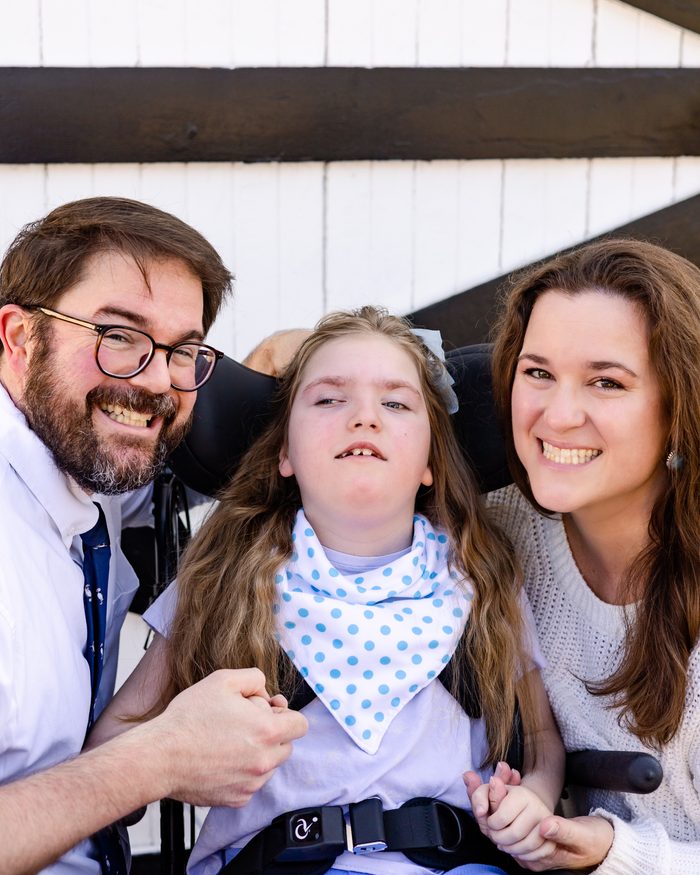
Snuggled in a corner of her living room couch, clutching a favorite plush cat she received on her recent birthday, Emma Hager opens her eyes.
“Good morning!” her father greets her.
Bud Hager gives his only child a loving smile as Emma’s light-blue eyes dance around the room, her gaze never fixing on an object.
Bud and his wife, Maggie, and Emma’s long-time care team at Rady Children’s Hospital Orange County, aren’t sure how well the 9-year-old can see.
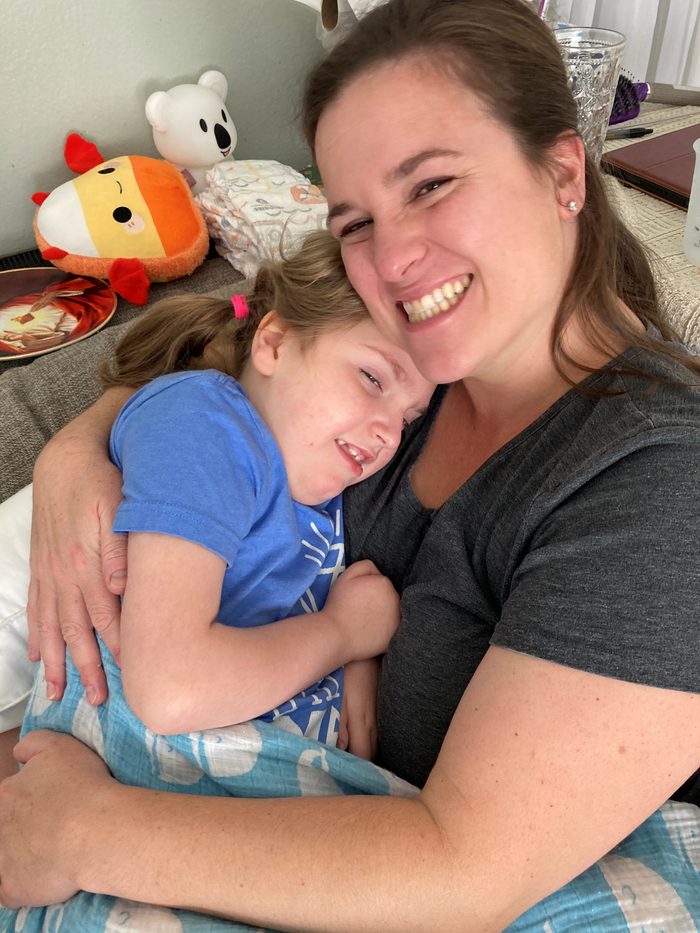
Born with a rare neurological disorder that has rendered her speechless and unable to move independently, her nutrition delivered through a G-tube, Emma also has a condition that makes her brain unable to properly process and interpret what is seen.
She uses an eye-tracking device equipped with infrared cameras and specialized software to translate her eye movements into computer commands or mouse clicks.
Emma’s hearing, however, is excellent. She will roll her eyes when Bud, who plays several instruments, gets pitchy when he sings to her.
“Sass is one of her main languages,” he says with a laugh.
This is her life
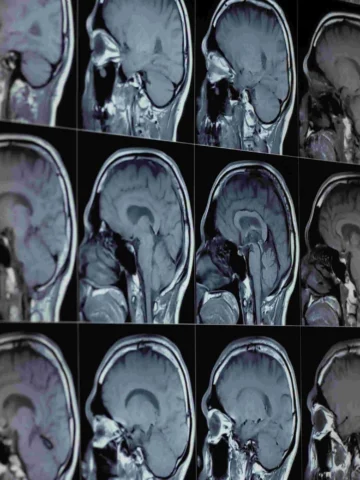
When Rady Children’s neurologists diagnosed Emma with pachygyria at 7 months old, they told Bud and Maggie she could live to age 6 months or 60 years, but that kids with her brain condition — which causes seizures or epilepsy, slow development, weak muscle, and movement disorders — typically die at 10.
This is going to be Emma’s life, doctors told them. Your job, they said, is to give her the best opportunity to live as comfortably as possible.
Emma recently turned 9.
Bud, whose flexible work hours allow him to be Emma’s primary caregiver, has found strength and motivation helping other parents of medically complex children.
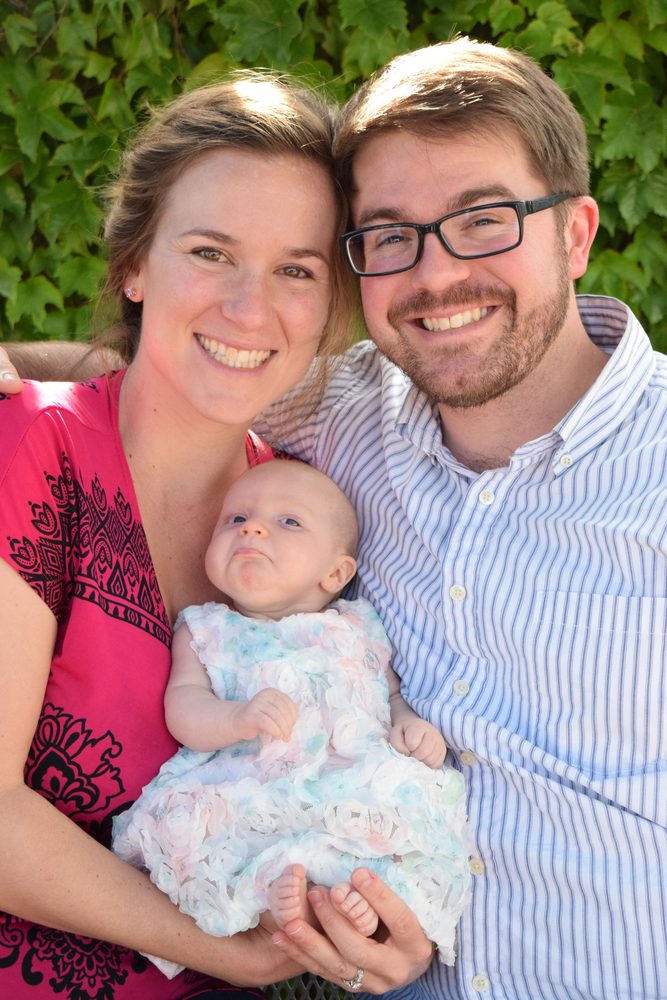
At Rady Children’s, he’s a member of the Patient and Family Advisory Council, the neurology department’s Clinical Practice Council, and is a parent mentor in the COPE program.
Maggie, a former bedside nurse, is a trove of information for other parents of medically complex children.
An adjunct professor of psychology at Chapman University and Santiago Canyon College who runs a private psychotherapy practice, Bud chronicles his experience caring for Emma through a blog run by the Courageous Parents Network. He also has a personal blog.
Making the best of things
In one Father’s Day post, Bud ponders the likelihood of outliving Emma.
If legacy is what flows from a father to a child, if it’s the thing that continues through them, then what happens when that future is uncertain?
I used to think I was Emma’s father in the sense that I came first, and she came from me. But the truth is, we made each other. She didn’t just receive care; she shaped the person giving it.
For Bud, being a good parent doesn’t mean he has everything figured out and that he can fix any problems that arise.
“I believe a parent is someone who takes what they have and makes the best out of it,” he says.
Bud keeps a meticulous journal of Emma’s condition, hour by hour when she’s awake, using red indicating bad moments such as seizures, yellow as doing OK, and green as good.
A significant decline
Neurologist and epilepsy specialist Dr. Maija-Riikka Steenari and pediatrician Dr. Angela Dangvu, Emma’s primary care doctor, are part of Emma’s specialty care team.
Others include Dr. Minodora Totoiu, who read Emma’s initial one-hour EEG and got her started on the right path to diagnosis; Dr. Sharief Taraman, who delivered the diagnosis; Dr. Touran Zadeh, who helped Bud and Maggie unravel Emma’s genetic mysteries; and Dr. Jeffrey Ho, who gave them a way to keep Emma alive with the G-tube.
“At every step along the way,” Bud says, “we never felt dismissed, rushed, or bothered. Every practitioner always has taken the time to be fully present with us.”
In addition to being prescribed medication for infantile spasms, Emma was put on an aggressive therapy regime for the first five years. She saw physical, speech, occupational, and visual therapists.
Last summer, the Hagers thought they were losing Emma after she showed signs of significant decline. She slept almost entirely during the month of September. Hospice was brought on service to help care for her.
In February, Bud and Maggie weaned her off the infantile spasm medication, tired of the brain fog and lethargy it caused.
“Our goal now is comfort,” Bud says.
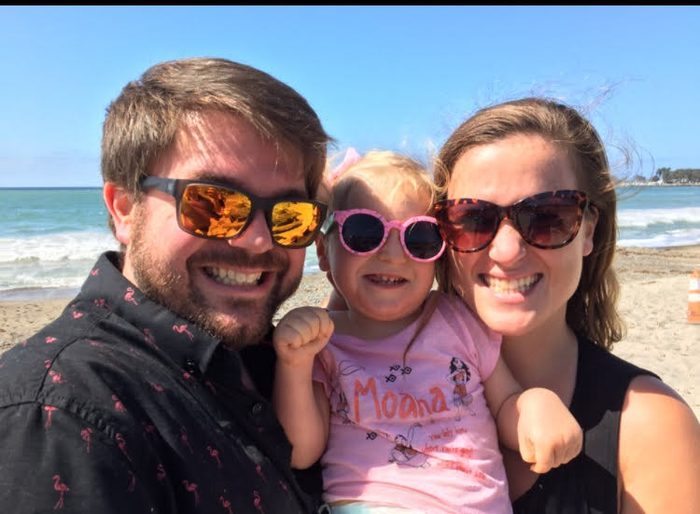
Emma, who is down to 45 pounds from 60 a couple of months ago, loves to be taken on neighborhood walks in her wheelchair and to her favorite spot: the beach.
Emma provides lessons
Gavin Hager, Emma’s godfather, says Emma has done more for him than he ever could do for her.
“She has such a beautiful soul with a strong will,” Gavin says. “Seeing her, knowing her story, her journey, has really made me want to be the best that I can.”
Emma has taught Gavin the value of determination.
“I see the persistence she has in the daily activities that most of us take for granted but are monumental tasks for her,” he says. “That doesn’t stop her, though. She keeps on fighting. She carries on with such inspiring ferocity.
“Regardless of any disabilities you may have or any obstacles you may come up against, Emma has shown me that if you have enough determination and the right support you can accomplish anything.”
Maria Phillips, Emma’s grandmother, says Emma’s existence brings her a joy she never thought was possible.
“And she keeps me present — not perfect, but present,” Maria adds.
Grandfather Dwayne Phillips loves to sing to Emma and hug her.
“She melts into you,” he says. “I always tell her she’s filling my heart up.”
Emma saves a life
Bud credits Emma with saving the life of a cousin.
When Maggie had spinal surgery in 2019, her brother moved in with the Hagers to help care for her. He became an expert at identifying her very subtle seizures, Bud says.
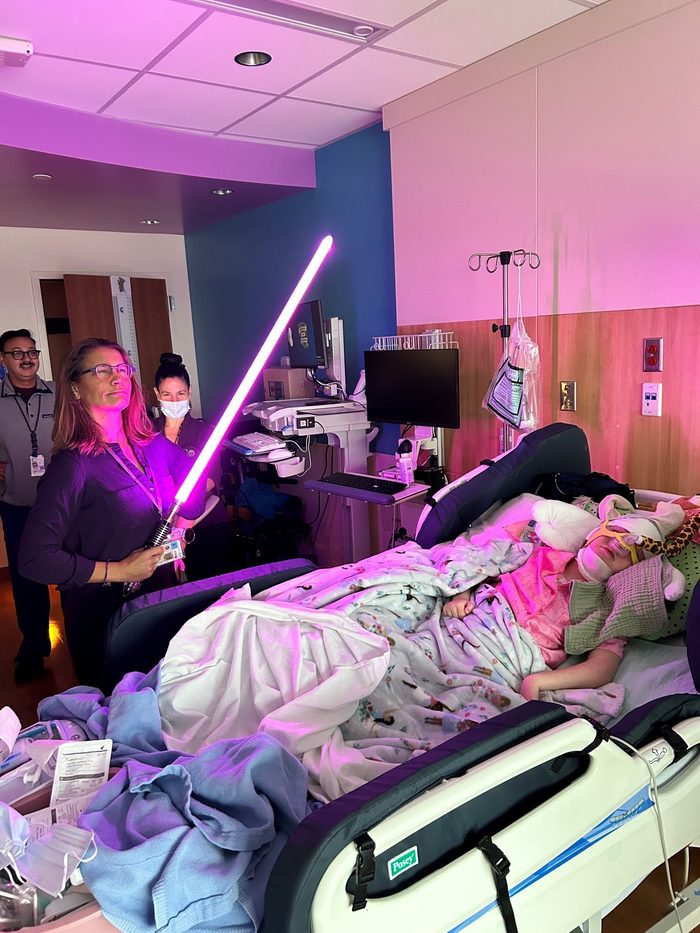
A few years later, Bud’s brother-in-law noticed his newborn son was experiencing strange movements that he thought might be seizures. A doctor immediately confirmed them and the baby was transferred to the Neonatal Intensive Care Unit (NICU) at Rady Children’s Hospital Orange County.
“My brother-in-law says that he only was able to recognize the movements because of Emma and if he hadn’t caught it there would have been a good chance his newborn son would have died or been severely disabled,” Bud explains.
“They all say that Emma saved him.”
Fr. Louis Hager, a Norbertine priest at St. Michael’s Abbey in Silverado and one of Bud’s nine siblings, has been a constant presence in Emma’s life.
“She has drawn the attention of so many by way of prayers to God on her behalf,” he says. “Many people I meet for the first time, after hearing my last name, ask me still to this day: Are you related to Emma? We’ve been praying for her!”
Emma saves souls, Fr. Louis says.
“Because of her suffering, she has caused so many people to pray like they never have before,” he says. “She may have, in her silent and unperceived way, effected more good on the supernatural side of all things than most of us ever will.”
Giving back
Bud says before Emma was diagnosed, he knew about Rady Children’s Health but didn’t know how much the hospital does to support families.
“Part of the reason I’m so involved is out of the hope that parents with kiddos of all levels of needs will have a better understanding of the unmatched support they can find here,” he says.
Bud first attended an event hosted by the Lamp Lighter Guild and decided to start his own parent support group. He and other patient fathers launched the Squires Guild in 2019.
“Building a community for parent caregivers is a passion so being able to sit at the intersection of peer and professional support is really special for us,” he says.
Cheer
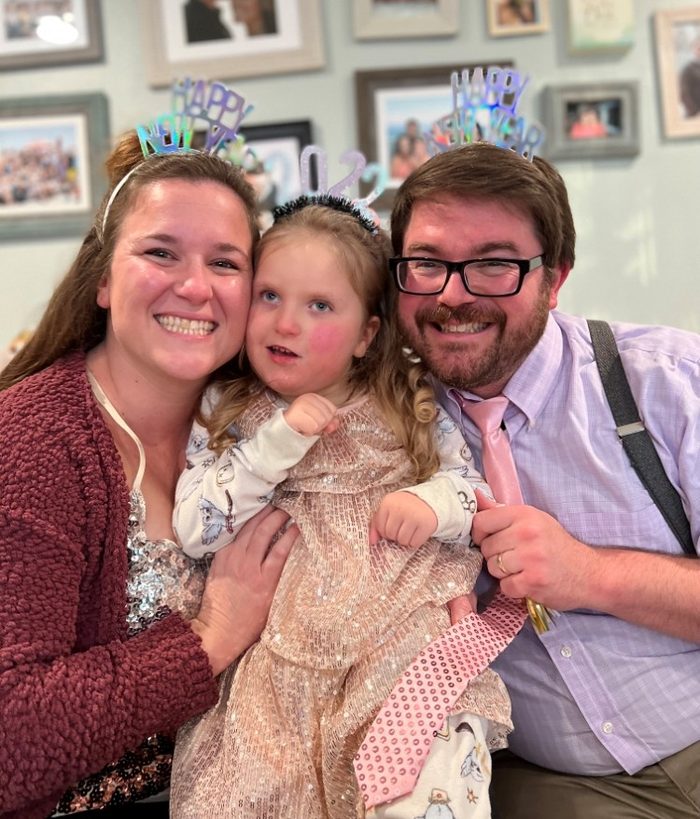
Bud and Maggie keep things cheerful at their home.
A zebra-striped outside ramp — the zebra is a symbol for a rare disease — leads to the front door.
The living room where Emma spends most of her waking hours is bright, the walls lined with books and photos.
Sweethearts who met in childhood in their native Orange County, Bud and Maggie, who wed in 2013, wanted at least three children. They thought twice after Emma’s diagnosis.
Six years ago, Maggie had a spinal tumor removed. Childbirth now is too risky for her.
A message for Emma
Asked what people can do to help him and Maggie, Bud says:
“If people were to love themselves and love their family to the point that becomes how they interact with the world around them, that helps Emma. If you are living in the way that you are aware of other people’s existence and open to other people’s experiences, that helps Emma and kids like her.”
In another blog post, Bud writes about hope:
It both crushes you down and opens you up …. Hope drags us through the sludge of reality and wakes us up to what needs to be done….
He addresses Emma:
When I say that I have hope for you, my daughter, I am not wishing for a world that
magically unfolds in your favor. I am committing myself to a way of living that leaves the world with no other option but to make room for you...
A world made not of wishes, but of work. Not built on glitter, but on gratitude. Not imagined or remembered from afar, but made here, in the present….
Hope, when it’s real, is simply love with its sleeves rolled up.
I hope you know how loved you are.
CHOC Hospital was named one of the nation’s best children’s hospitals by U.S. News & World Report in its 2025-26 Best Children’s Hospitals rankings and ranked in the neurology/neurosurgery specialty.