Until recently, allogeneic bone marrow transplant represented the only curative opportunity for the approximately 100,000 people in the U.S. with sickle cell disease.
Now, gene therapy also offers the potential to cure this debilitatingly painful condition, and Rady Children’s Health Orange County is at the forefront of ensuring access for patients.
That effort achieved a key milestone in October 2025, when a then 19-year-old woman became the first at the hospital to receive Casgevy®, a single-dose, CRISPR/Cas9-based gene therapy. Casgevy received FDA approval in 2023, one of the first two gene therapies authorized to treat sickle cell disease in patients age 12 and older.
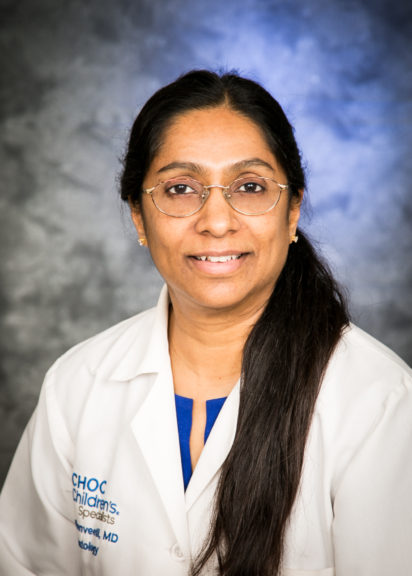
Pediatric hematologist Dr. Geetha Puthenveetil led the effort to bring Casgevy to Rady Children’s Health Orange County and administered the first treatment. For her, the moment held extra significance as a vision she’d been striving toward since the beginning of her career became a reality.
An early belief in gene therapy’s potential
Dr. Puthenveetil became interested in sickle cell disease and thalassemia during her medical training in South India, where the disorders have a significant prevalence. During her hematology/oncology fellowship at Children’s Hospital Los Angeles, she joined a project to advance gene-transfer therapies for hemoglobinopathies.
“I extracted stem cells from patients with thalassemia, put the cells through the gene therapy process in petri dishes, injected them into immunodeficient mice and saw gene-corrected cells produce normal hemoglobin,” Dr. Puthenveetil says. “It was transformational.”
In 2004, the year she finished her fellowship, Dr. Puthenveetil and her colleagues published their work on gene transfer using lentiviral vectors in a plenary paper in the journal Blood.
“My fellowship experience laid the groundwork for my interest in gene therapy,” she says. “I’d always been interested in thalassemia and sickle cell disease from a clinical perspective, but this research opened my eyes to the genetics of these conditions and how we could potentially cure them with gene therapy.”
The future arrives
Nearly 20 years later, Dr. Puthenveetil saw gene therapy’s real-world potential come to fruition when the FDA approved Casgevy, which uses gene editing rather than gene transfer.
“We were excited about Casgevy, and I knew it was coming down the pike because of early data from research trials,” she says. “We started laying the foundation for getting this product at our hospital even before FDA approval.”
When it was time to select a patient to receive the inaugural treatment, Dr. Puthenveetil had an ideal candidate in mind.
‘I dealt with these symptoms my whole life’
Sickle cell disease added layers of complexity to Jai Marie Murphy’s life for as long as she could remember. Passionate about dance, she had to quit for years because of sickle cell-related pain. The symptoms caused her to miss so many days of school that she almost failed several grades. On family ski trips, she could only stay outdoors for a couple of hours at a time because the cold would trigger pain crises.

“Sometimes, the pain would be really sharp, like a knife stabbing me,” Jai Marie says. “It mainly affected my middle and lower back. Other times, I would have a constant aching, and it would hurt to get out of bed. I dealt with these symptoms my whole life.”
A bone marrow transplant was not an option for Jai Marie. When Dr. Puthenveetil, who had cared for her since infancy, approached her about receiving Casgevy, Jai Marie was both eager and nervous for the opportunity.
“I kept telling my mom I wished someone else would go first,” Jai Marie says. “But at the same time, I didn’t want to wait any longer.”
Targeting hemoglobin F suppression
In 2025, Jai Marie went through the painstaking process of preparing to receive Casgevy. She underwent apheresis to harvest stem cells for editing, and then months of manufacturing and quality checks on edited cells followed before Jai Marie received chemotherapy to reduce the risk of rejection before the infusion.
The goal of the treatment was to increase Jai Marie’s levels of hemoglobin F (HbF), or fetal hemoglobin, which is the predominant hemoglobin in fetuses during the intrauterine period. HbF disrupts cell sickling in individuals with sickle cell disease. HbF declines after birth, and other types of adult hemoglobin increase.
“The BCL11A gene controls HbF production,” Dr. Puthenveetil says. “When turned on, this gene suppresses HbF production. Casgevy targets the BCL11A gene and turns it off, allowing HbF production to switch back on again. As a result, the HbF level rises to 45%–50% and directly decreases sickling in the red blood cells. The patient still has their sickle gene, but because of the high amount of HbF, they don’t have as many pain crises, or the crises disappear completely.
That is what happened to Jai Marie. Months after receiving Casgevy in October 2025, the now 20-year-old college student can dance in back-to-back performances without worrying about pain or whether she’ll have the strength to go to work the next day. She is looking forward to the start of the new semester.
“It’s been a night-and-day difference,” Jai Marie says. “I had pain somewhere in my body every day for as long as I could remember. Now, it’s completely gone.”
For Dr. Puthenveetil, it’s a deeply gratifying result.
“I was able to see gene therapy go from bench to bedside,” she says. “As physician-scientists, that’s what we aim for.”
This journey also included yeoman efforts from multiple teams in the hospital including the therapeutic apheresis team, the stem cell lab personnel, case management team, pharmacy and laboratory personnel, financial coordinators and hospital administration.
“It truly takes a high-functioning multidisciplinary team to deliver a complex treatment modality such as gene therapy to our patients with hemoglobinopathies,” Dr. Puthenveetil says.
More patients poised to benefit
Three more patients with hemoglobinopathies are in various stages of preparation to receive Casgevy at Rady Children’s Health Orange County. Recently, the FDA approved the product for children ages 2 and older with sickle cell disease or thalassemia, expanding the pool of eligible patients. In addition, Dr. Puthenveetil is working to bring two gene insertion therapies for hemoglobinopathies to Rady Children’s Health Orange County.
Administering Casgevy at Rady Children’s Health Orange County represented more than a rare instance of a researcher witnessing translational medicine come full circle during her career. It also reflected the hospital’s leadership in an innovative therapy that, with the dedication and vision of physician-scientists like Dr. Puthenveetil, may transform countless lives in the decades to come.
Learn how the hematology program at Rady Children’s Health Orange County provides leading-edge, comprehensive treatment for blood and bone marrow disorders.